Tony Crisp’s Private Mass Surveillance Network: Maryville’s Flock Safety Program and the Fourth Amendment
Chief Tony Jay Crisp’s department brought Flock Safety mass surveillance to Maryville, expanded it through a direct vendor relationship, and committed the City to it before the public was ever asked. This page is the primary MaryvillePrivacy.org record of that program: what it does, how it was put in place, why MaryvillePrivacy.org describes the result as Tony Crisp’s Private Mass Surveillance Network, and what it looks like in real life for an ordinary Maryville resident.
☰ Jump to
Tony Crisp Lost the District 8 Republican Primary
Maryville Police Chief Tony Jay Crisp was defeated by Jordan Henderson by nearly 25 percentage points — despite Crisp raising more than twice as much money and spending nearly three times as much.
|
62.4%
Jordan Henderson
5,873 votes · WINNER
|
37.6%
Tony Jay Crisp
3,540 votes
|
CRISP
├── raised   ≈ $148,063
└── spent    ≈ $140,231

HENDERSON
├── raised   ≈ $68,179
└── spent    ≈ $47,768

RESULT
└── Henderson +2,333 votes
MaryvillePrivacy.org endorsed no candidate and does not claim that Flock or surveillance caused Crisp’s defeat. Voters make decisions for many reasons. The documented fact is narrower: the public record surrounding Maryville’s surveillance program circulated during the campaign, and Crisp did not win the legislative seat.
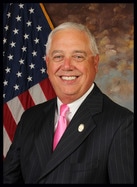
The election ended Crisp’s 2026 legislative campaign — not Maryville’s Flock program. He remains Police Chief and Director of Public Safety, and the surveillance network documented on this page remains an active public-accountability issue.
The question now is not about Candidate Crisp. It is about Police Chief Crisp: what surveillance power his department built, what safeguards govern it, and whether those safeguards are sufficient.
View official election-result image
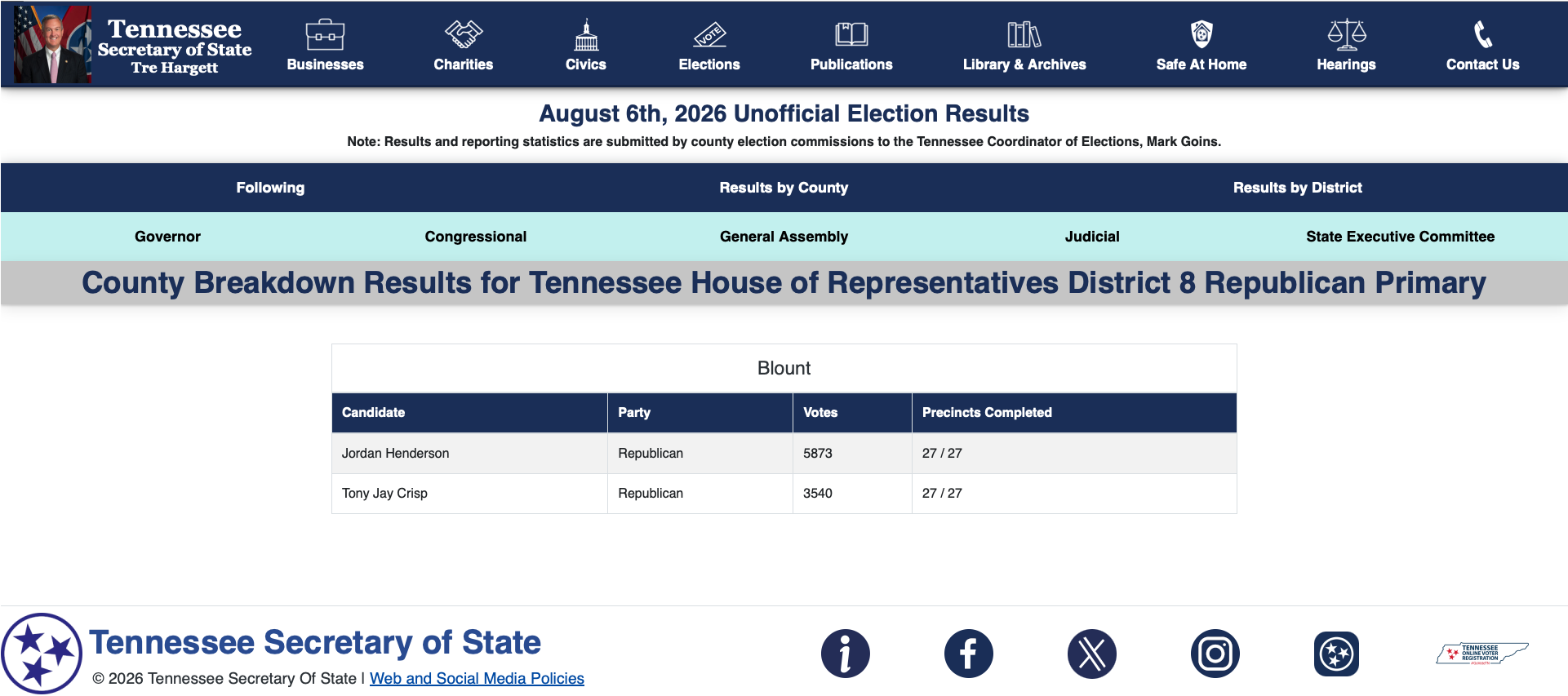
Sources: Tennessee Secretary of State; The Daily Times; campaign-finance figures compiled from Tennessee Registry of Election Finance filings by Who Funds Tennessee.
Tony Crisp’s Private Mass Surveillance Network
Flock calls its product a public-safety tool. MaryvillePrivacy.org describes the documented Maryville system by what it does: public roads, public infrastructure, and public money are used to collect vehicle-location data that is stored and searched through a private vendor platform.
The phrase is not an allegation of criminal wrongdoing. It is a criticism of the surveillance architecture and its safeguards: ordinary drivers are recorded without individualized suspicion, while Maryville has not produced a written local policy governing searches, approvals, audits, or Safe List use.
What Maryville’s Own Dashboard Recorded
This Flock operational dashboard was produced for Maryville Police and released by the City under the Tennessee Public Records Act. It shows the scale and pattern of vehicle collection during a reporting window beginning October 18, 2024.
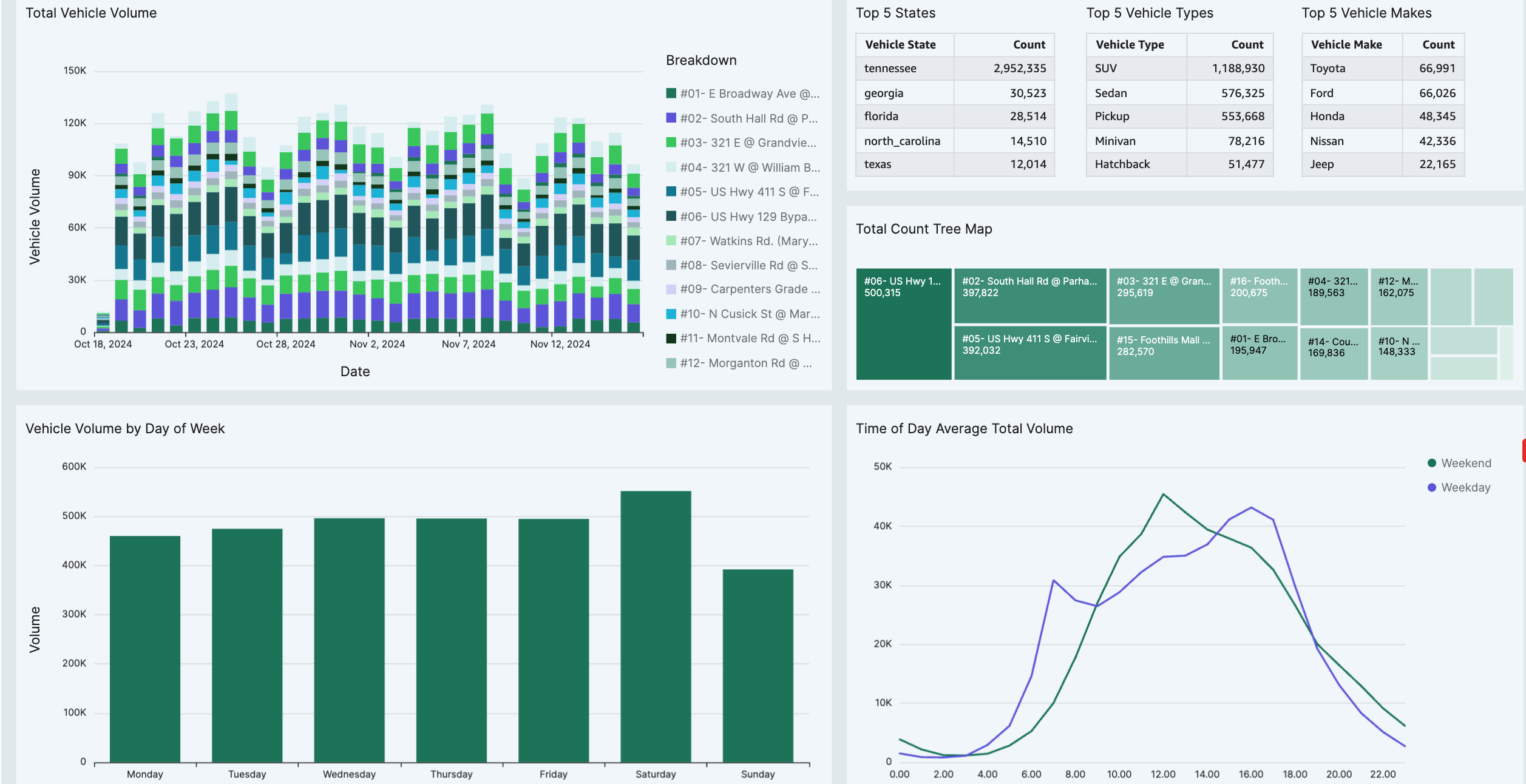
The system records ordinary traffic at enormous scale. Tennessee-plated vehicles dominate the data, common SUVs and everyday vehicle makes dominate the classifications, and traffic rises and falls with normal driving patterns.
These numbers are camera reads, not unique vehicles. The same car can be photographed repeatedly as it travels past different cameras or returns along the same route.
Source: Flock Safety operational analytics dashboard for Maryville Police, released under the Tennessee Public Records Act. Reporting window beginning October 18, 2024.
The technology documented on this page is not theoretical. It is part of Maryville’s real public-safety infrastructure and should be evaluated with the same scrutiny as any other government system capable of recording residents’ movements.
The Fourth Amendment Does Not End at Your Property Line
“The right of the people to be secure in their persons, houses, papers, and effects, against unreasonable searches and seizures, shall not be violated, and no Warrants shall issue, but upon probable cause, supported by Oath or affirmation, and particularly describing the place to be searched, and the persons or things to be seized.”
Fourth Amendment to the United States Constitution
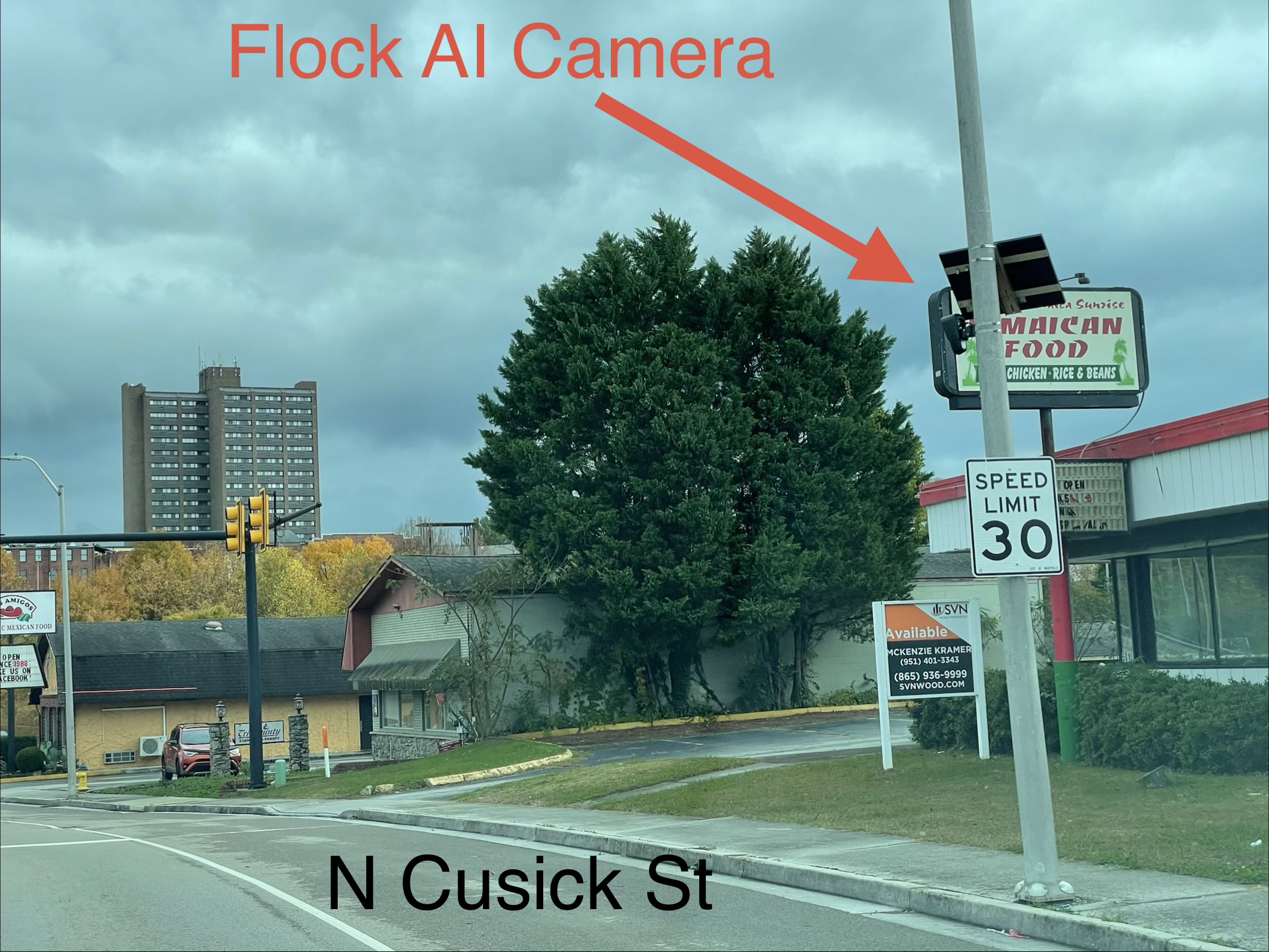
Some defenders of ALPR surveillance argue that if a vehicle is visible from a public road, the Fourth Amendment concern disappears. That argument is too small for the constitutional problem modern surveillance creates. The issue is not whether an officer may see a car on a road. The issue is whether the government may build, buy, or access a searchable historical database of ordinary people’s movements without a warrant.
Constitutional rights do not vanish the moment a person leaves home. The First Amendment does not protect speech only inside your living room. The Second Amendment does not apply only while standing on your own property. The Fourth Amendment should not be treated as if it ends at the edge of your driveway.
The public-policy charge is simple: Chief Crisp’s department did not merely use a camera. It helped route Fourth Amendment-sensitive location data through a private company.
In plain language, MaryvillePrivacy.org’s critique is that Tony Crisp’s surveillance program has effectively handed Fourth Amendment protections to a private vendor model: public roads, public poles, public money, private database, government access, no warrant, no notice, and no produced written search policy. That is a constitutional stewardship problem, even if no court has yet ruled on Maryville’s specific system.
A Searchable Vehicle-Location Network on Public Roads
Maryville did not simply install 16 cameras. It created a system that turns passing vehicles into searchable records containing plate, vehicle, time, and location data.
The constitutional issue is not simply that a camera sees a license plate. It is that government-deployed cameras continuously create location records that are stored in a vendor-hosted system and can later be searched by authorized users.
Committed to the Vendor and the State Before the Council Voted, and Before Any Resident Was Asked
Records from the City of Maryville, Flock Safety, and the Tennessee Department of Transportation document the order in which Maryville’s ALPR program was actually decided. Before the City Council ever voted, Flock had drawn site-specific engineering plans for a Maryville installation, Chief Crisp had designated Flock Safety as the City’s agent and preferred contractor, and Crisp had signed and certified the City’s application to the State to install cameras in state right-of-way. The elected body did not act until July 2, 2024, and it acted with no public hearing.
|
April 22, 2024
Site-specific engineering plans already drawn.
Flock Safety prepares a preliminary engineering plan set for an ALPR installation on W. Lamar Alexander Parkway, drawn “on behalf of Maryville Police Department” for TDOT permitting, with pole locations, coordinates, and camera specifications. The project is already at the permit-drawing stage.
|
|
May 24, 2024
Vendor designated as the City’s agent and preferred contractor.
On Maryville Police Department letterhead, Chief Crisp signs an “Authorization of Agent” naming Flock Safety as the City’s agent to apply for the Tennessee DOT encroachment permit and “act on my behalf,” and as the Department’s “preferred contractor” to perform the work. No competitive process precedes this designation.
|
|
May 31, 2024
State application signed and certified by the Chief.
Chief Crisp signs the City’s TDOT application to install and operate ALPR cameras in state right-of-way, certifying the information “true and accurate” as Chief of Police, under the statute cited on the form, Tenn. Code Ann. section 55-8-198(f). On the same day, Lt. Fernandez’s letter to the Maryville Electric Department requests permission to mount Flock cameras on city utility poles; the pole attachment is later approved by MED as a solar-powered “Notice to Attach.”
|
|
July 2, 2024
Council votes, with no public hearing.
Resolution 2024-14 endorses and approves the installation, more than five weeks after the agent authorization and the signed state application. Its own text describes the Department as having “for numerous years operated LPR/Cameras,” framing the vote as blessing an existing practice. No public hearing was held.
|
|
November 7 to 11, 2024
State license executed for ten years.
Chief Crisp signs a TDOT license running November 7, 2024 to November 6, 2034, at a $0 annual fee to the State, binding the Maryville Police Department for ten years.
|
From paperwork to pavement: the surveillance network being physically upgraded
These photographs document a technician working at the City of Maryville’s Flock camera location on Court Street. The sequence shows the physical roadside equipment behind the contracts, permits, databases, and surveillance capabilities described above.
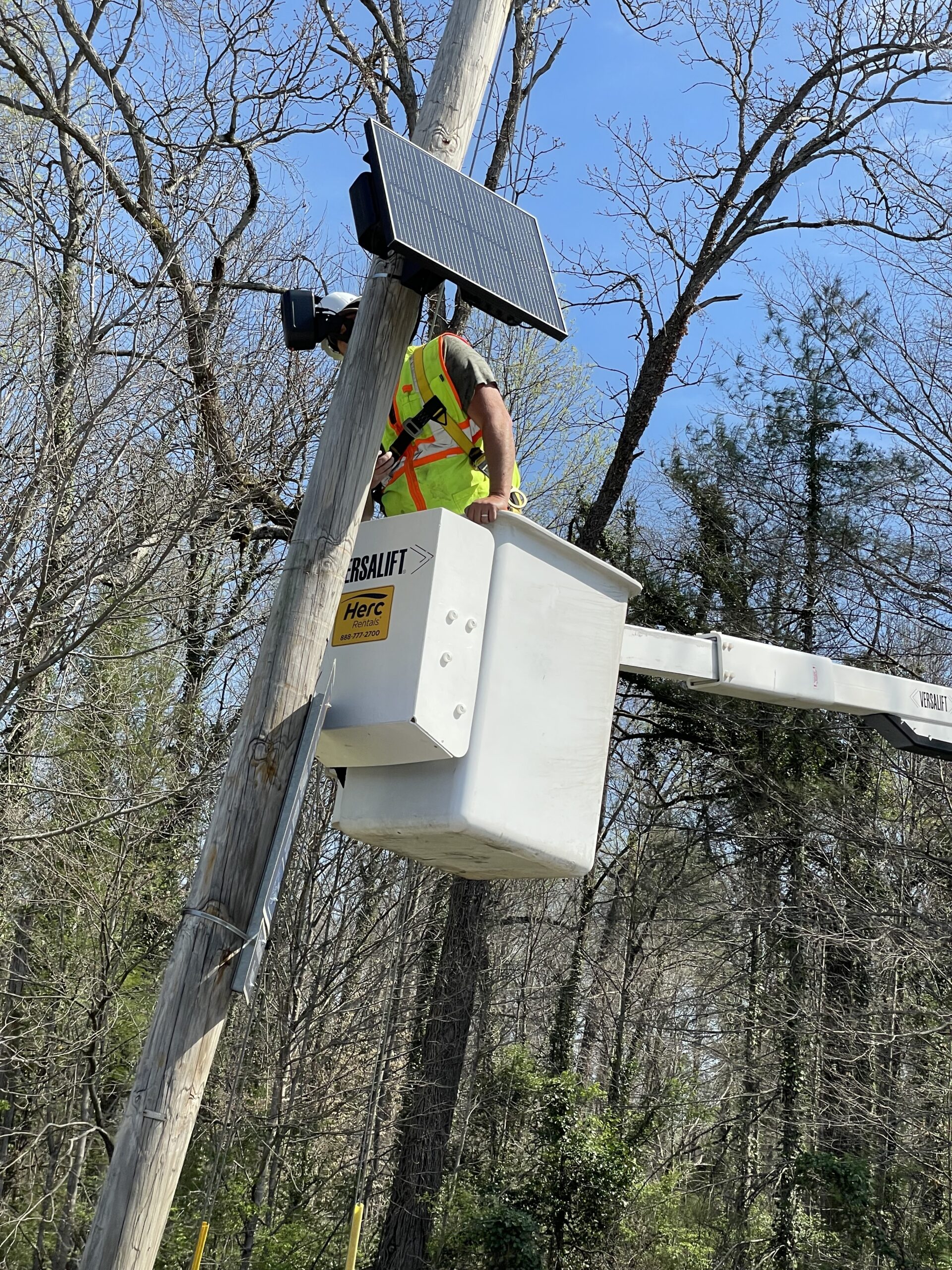
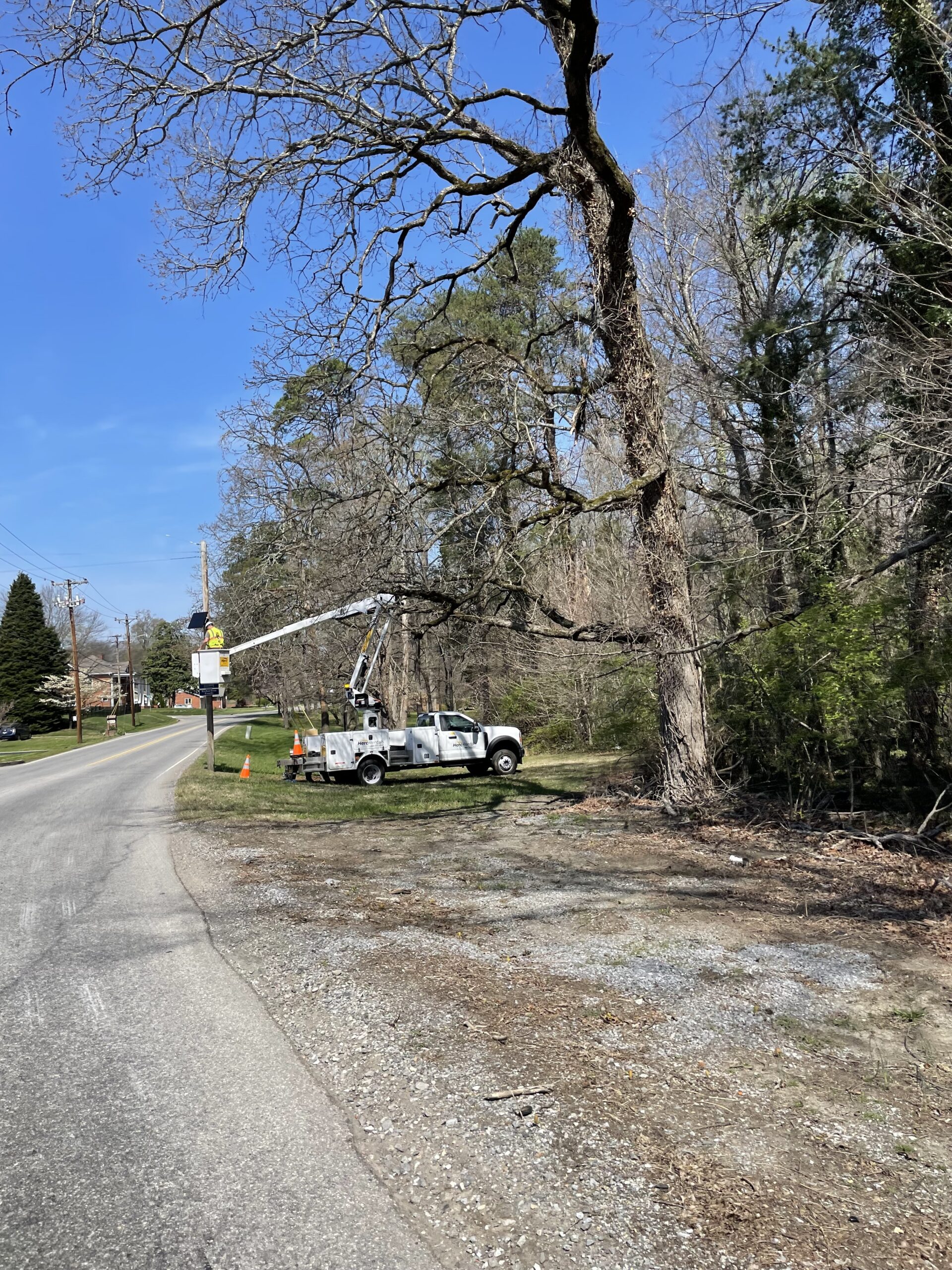
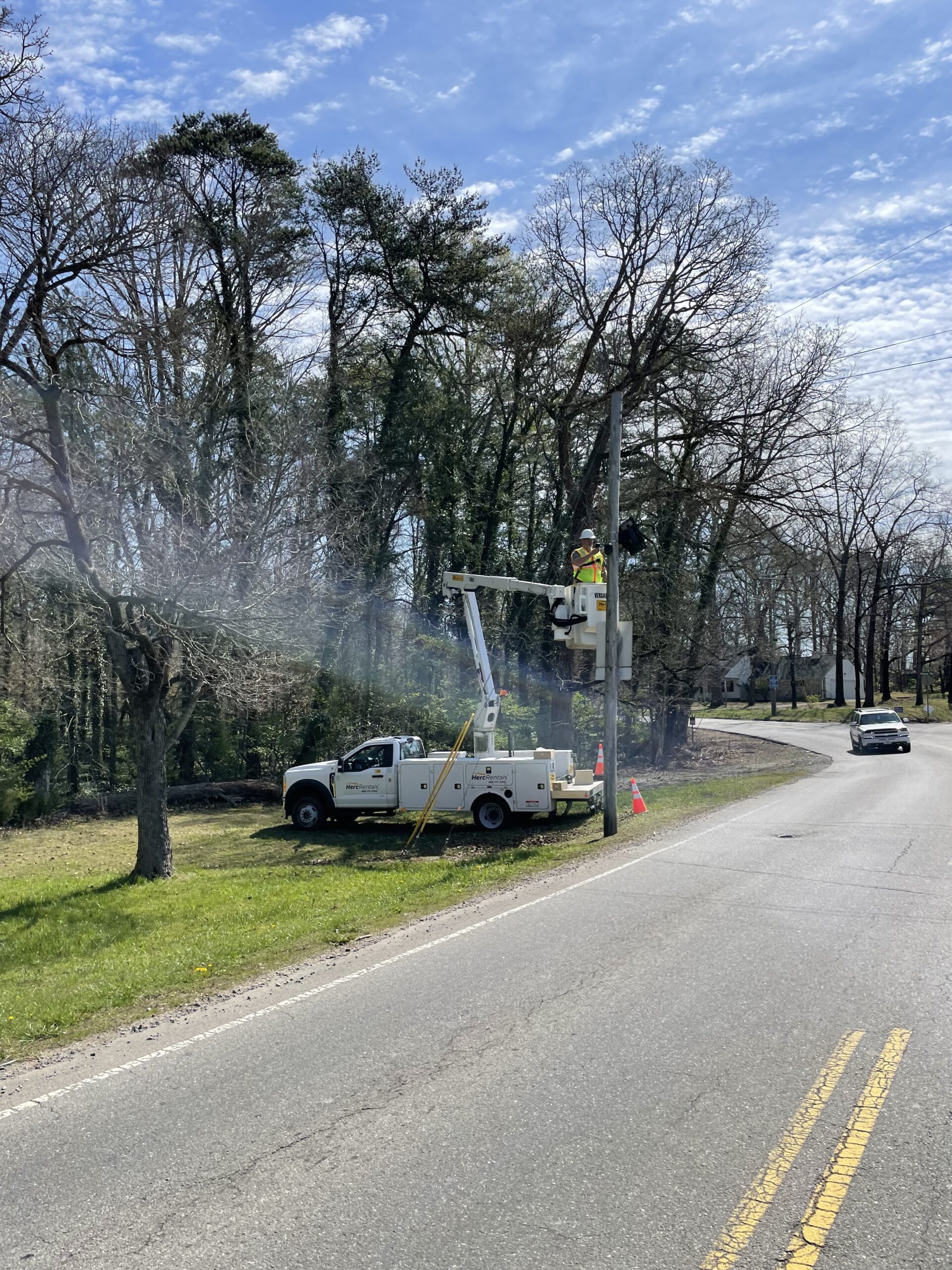
Why these photographs matter: the surveillance system described in the records above is not abstract software. It depends on physical cameras installed and maintained along Maryville roadways. Software and investigative capabilities can change later, but this roadside collection infrastructure is already in place.
Field photographs: Court Street, Maryville, Tennessee · September 2026 · Maryville Residents for Privacy documentation.
What the state’s own application required
The TDOT application form sets out its own order of operations. In the note for local law enforcement applicants, it states that the applicant must obtain, and provide documentation of, the local legislative body’s approval of the proposal “before submitting the application to TDOT.” The application was signed and certified on May 31, 2024. The City Council did not vote until July 2, 2024, more than five weeks later.
Read together, the records show the substantive decisions were made before the public body acted and before the public was told. By July 2, the vendor had already been designated as the City’s agent and preferred contractor, the state application had already been signed and certified, and the elected body’s role was reduced to endorsing a program that was already in motion. No public hearing was held. No resident was notified.
The question the record raises: the issue is not only whether each step was lawful. It is whether the decision to place a city’s entire driving public under continuous automated surveillance should be set in motion by one official signing forms, weeks before the elected council votes, and without a single resident being asked.
Primary Source Documents
- Flock Safety preliminary ALPR engineering and site plans, “on behalf of Maryville Police Department,” dated April 22, 2024 (PDF)
- Maryville Police “Authorization of Agent” naming Flock Safety, signed by Chief Crisp, May 24, 2024 (PDF)
- Maryville TDOT ALPR application, signed and certified by Chief Crisp, May 31, 2024 (PDF)
- Maryville Electric Department “Notice to Attach,” approving pole attachment for the Flock cameras (PDF)
- Maryville City Council Resolution 2024-14, July 2, 2024 (PDF)
- TDOT ALPR license agreement, Request No. 7419, signed by Chief Crisp and executed by the State, November 2024 (PDF)
Sources: Flock Safety preliminary ALPR engineering and site plans (April 22, 2024); Maryville Police Authorization of Agent (May 24, 2024); Maryville TDOT ALPR application signed by Chief Crisp (May 31, 2024); Maryville Electric Department Notice to Attach; Maryville City Council Resolution 2024-14 (July 2, 2024); TDOT ALPR license agreement, Request No. 7419, executed November 2024. All linked above.
Illustrative example, not a specific person. The point is to show how ordinary, lawful travel can become searchable movement data.
One Law-Abiding Driver. Four Ordinary Days.
Nothing below requires the driver to commit a crime. The surveillance value comes from connecting otherwise ordinary events.
The important change is not any one camera read. It is what happens when many ordinary reads are connected by time, location, and plate number.
An officer elsewhere may now be able to see that the same vehicle traveled from Tennessee, appeared near certain locations, and continued into another jurisdiction.
Legal activities can become investigative context simply because the system remembers where the vehicle was.
That is the civil-liberties concern: conduct that would attract no attention when observed once can look very different after a surveillance system assembles it into a historical pattern.
For Maryville’s documented use of travel-pattern tools, see Flock’s Multi-Geo and Convoy Tools .
You probably did nothing illegal today.
You drove to work, school, a store, a doctor’s office, a friend’s house, or home. Those are ordinary movements. But when camera reads are stored, searched, and shared, an ordinary day can become a government-accessible travel history.
If you are not suspected of a crime, why should your ordinary movements be collected first and questioned later?
NO WARRANT
    │
NO SUSPICION
    │
ORDINARY TRAVEL
    │
    ▼
SEARCHABLE LOCATION DATA
The camera is visible. The historical database behind it is the part most residents never see.
The Constitutional Issue Is the Searchable History
Seeing one car on a public road is not the same as automatically recording thousands of vehicles, attaching time and location, storing the records, and making them searchable later.
ONE CAMERA READ
      │
      ▼
TIME + LOCATION
      │
      ▼
MANY CAMERA READS
      │
      ▼
SEARCHABLE HISTORY
Maryville residents do not have to be suspected of a crime before their vehicles are captured and added to the system.
That is the Fourth Amendment concern: ordinary travel can become government-accessible location history without a warrant or individualized suspicion.
The policy question is therefore larger than whether a camera may photograph a plate. It is who may search the resulting history, for what purpose, and under what oversight.
What the Maryville Network Actually Is
Most residents picture Maryville’s Flock program as a camera on a pole. The camera is only the outer edge of the system. The map below shows the broader documented infrastructure, including the point where vehicle reads can follow different system paths depending on whether a plate is placed on a whitelist or Safe List.
              ROADSIDE FLOCK CAMERAS
                       │
                       ▼
                 VEHICLE DATA
                       │
         ┌─────────────┴─────────────┐
         │                           │
         ▼                           ▼
   FLOCK CLOUD                AXON FLEET 3
         │                    / EXTERNAL DATA
         │                           │
         └─────────────┬─────────────┘
                       │
                       ▼
                 VEHICLE READ
                       │
                       ▼
              WHITELIST / SAFE LIST?
                       │
             ┌─────────┴─────────┐
             │                   │
            YES                  NO
             │                   │
             ▼                   ▼
      LIMITED / SUPPRESSED    NORMAL DATABASE
          TREATMENT             WORKFLOW
             │                   │
             │          ┌────────┼────────┐
             │          │        │        │
             │          ▼        ▼        ▼
             │       SEARCH    ALERTS   HISTORY
             │          │        │        │
             │          └────────┼────────┘
             │                   │
             └───────────┬───────┘
                         │
                         ▼
                  OFFICER ACCESS
                         │
            ┌────────────┼────────────┐
            │            │            │
            ▼            ▼            ▼
        STATION       PATROL       MOBILE
        COMPUTER      COMPUTER      DEVICE
                         │
                         ▼
                   AUDIT LOG
                         │
                         ▼
                    OVERSIGHT
MARYVILLE FLOCK NETWORK
│
├── DATA COLLECTION
│   │
│   ├── Roadside Flock cameras
│   │
│   └── Axon Fleet 3
│       └── external camera source
│
├── VEHICLE READ
│   │
│   ▼
│   WHITELIST / SAFE LIST?
│   │
│   ├── YES
│   │   │
│   │   └── limited or
│   │       suppressed treatment
│   │
│   └── NO
│       │
│       └── normal database
│           workflow
│           │
│           ├── search
│           ├── alerts
│           └── history
│
├── OFFICER ACCESS
│   │
│   ├── station computer
│   ├── patrol computer
│   └── mobile device
│
└── ACCOUNTABILITY
    │
    ├── audit log
    └── oversight
The whitelist or Safe List issue matters because selected vehicles can be treated differently from everyone else. A listed vehicle may receive limited or suppressed treatment within normal system workflows, while vehicles not placed on that list continue through the ordinary searchable database, alert, and history functions.
See the Maryville records: Flock Whitelist & “Ghost Vehicles” →That creates an obvious oversight question: who can place a vehicle on the whitelist or Safe List, what qualifies a vehicle for different treatment, how long does that status last, and who audits those decisions?
The detailed tree below breaks that same system into its documented layers: who can reach it, what it collects, where the data goes, how long it is kept, how widely it is shared, and how thinly it is overseen. It reflects Maryville’s own records together with Flock’s published description of how its platform is accessed.
MARYVILLE POLICE → FLOCK SURVEILLANCE INFRASTRUCTURE
│
│
├── 1. OFFICER ACCESS
│   │
│   ├── Police station
│   │   ├── desktop computers
│   │   └── office laptops
│   │
│   ├── Patrol vehicle
│   │   └── cruiser laptop / MDT-style computer
│   │
│   └── Mobile device
│       └── city-issued mobile phone
│
│       Each authorized user can have an
│       individual Flock account.
│
│
├── 2. HOW AN OFFICER CAN REACH FLOCK
│   │
│   ├── Individual officer account
│   │   │
│   │   ├── authentication / login
│   │   │
│   │   └── agency-controlled permissions
│   │
│   ├── FlockOS / web interface
│   │   ├── desktop
│   │   ├── laptop
│   │   ├── tablet
│   │   └── mobile
│   │
│   └── Flock Safety mobile app
│       ├── iPhone
│       └── Android
│
│
├── 3. MARYVILLE DATA INPUTS
│   │
│   ├── Roadside Flock ALPR cameras
│   │   │
│   │   └── each vehicle detection can produce
│   │       ├── vehicle image
│   │       ├── license plate read
│   │       ├── date
│   │       ├── time
│   │       ├── camera location
│   │       └── vehicle characteristics
│   │
│   └── Axon Fleet 3 cruiser cameras
│       │
│       ├── mounted on patrol vehicles
│       │
│       └── documented in Maryville's Flock
│           interface as an "External Source"
│
│           This means the surveillance network
│           is not limited to fixed roadside cameras.
│
│
├── 4. DATA FLOWS INTO THE FLOCK CLOUD
│   │
│   ├── roadside camera detections ─────────┐
│   │                                       │
│   ├── Axon Fleet 3 detections ────────────┤
│   │                                       │
│   └── integrated/external data ───────────┤
│                                           │
│                                           ▼
│                              FLOCK CLOUD PLATFORM
│                                           │
│                                           ├── stores records
│                                           ├── indexes records
│                                           ├── associates time
│                                           ├── associates location
│                                           └── makes records searchable
│
│
├── 5. WHAT THE SEARCH SYSTEM CAN PROVIDE
│   │
│   ├── License-plate lookup
│   │
│   ├── Historical vehicle sightings
│   │   ├── where a vehicle was seen
│   │   └── when a vehicle was seen
│   │
│   ├── Vehicle images
│   │
│   ├── Vehicle attributes
│   │
│   ├── Hotlists
│   │
│   ├── Real-time alerts
│   │
│   ├── Safe Lists / whitelists
│   │
│   ├── map-based results
│   │
│   ├── time-based results
│   │
│   └── multiple sightings that can reveal
│       patterns of vehicle movement
│
│
├── 6. THE DIFFERENCE BETWEEN A CAMERA
│      AND A SEARCHABLE MOVEMENT DATABASE
│   │
│   ├── A roadside camera records one observation.
│   │
│   └── A searchable network can connect observations.
│       │
│       ├── WHERE was the vehicle?
│       │
│       ├── WHEN was it there?
│       │
│       ├── WHERE was it seen next?
│       │
│       └── WHAT pattern do those sightings reveal?
│       │
│       ▼
│
│       ONE CAMERA
│           │
│           └── one vehicle sighting
│
│       MANY CAMERAS
│           │
│           └── many vehicle sightings
│
│       SEARCH + TIME + LOCATION
│           │
│           └── movement history
│
│
├── 7. MARYVILLE'S PUBLISHED RETENTION
│   │
│   ├── Maryville
│   │   └── 30-day published retention period
│   │
│   └── Tennessee law
│       └── permits governmental ALPR data
│           retention up to 90 days,
│           subject to statutory exceptions
│
│       Maryville's 30-day period is therefore
│       a local retention choice below the
│       Tennessee statutory maximum.
│
│
├── 8. MARYVILLE'S SHARING NETWORK
│   │
│   ├── Maryville ALPR data
│   │   │
│   │   └── Flock portal identifies
│   │       outside organizations granted
│   │       access to Maryville TN PD data
│   │
│   ├── Previous full portal capture
│   │   │
│   │   └── 1,000+ outside organizations
│   │       were listed as having access
│   │       to Maryville ALPR data
│   │
│   └── Sharing can extend beyond Maryville
│       │
│       ├── other police departments
│       ├── sheriff's offices
│       ├── Tennessee agencies
│       ├── out-of-state agencies
│       ├── task forces
│       └── federal organizations
│
│
├── 9. WHAT "SHARING" CHANGES
│   │
│   ├── WITHOUT NETWORK SHARING
│   │   │
│   │   └── Maryville camera
│   │       └── Maryville user
│   │
│   └── WITH NETWORK SHARING
│       │
│       └── Maryville camera
│           │
│           └── Maryville vehicle record
│               │
│               ├── Maryville users
│               └── authorized outside organizations
│                   │
│                   └── potentially nationwide reach
│
│
├── 10. AUDIT LOGGING
│   │
│   ├── Flock records user search activity
│   │
│   ├── individual accounts can identify
│   │   which authorized user performed a search
│   │
│   └── BUT
│       │
│       ├── an audit log records activity
│       │   after or as it occurs
│       │
│       └── an audit log is not necessarily
│           a preventive control
│
│           LOGGING A SEARCH
│                 ≠
│           PREVENTING A SEARCH
│
│
├── 11. THE DEVICE QUESTION
│   │
│   ├── Maryville records can establish
│   │   that individual users searched Flock
│   │
│   └── those records do not necessarily establish
│       the physical endpoint used for every search
│       │
│       ├── station desktop?
│       ├── office laptop?
│       ├── cruiser computer?
│       └── mobile phone?
│
│       The important infrastructure point is that
│       Flock is designed for access across desktop,
│       laptop, tablet and mobile environments.
│
│
├── 12. CYBERSECURITY ATTACK SURFACE
│   │
│   ├── Flock access is not inherently limited
│   │   to one secured terminal at police headquarters.
│   │
│   ├── Potential authorized endpoints include
│   │   ├── station computers
│   │   ├── laptops
│   │   ├── patrol-car computers
│   │   └── mobile devices
│   │
│   └── More endpoints can mean more
│       │
│       ├── user credentials to protect
│       ├── devices to secure
│       ├── software to update
│       ├── authentication sessions
│       ├── opportunities for stolen credentials
│       ├── opportunities for lost devices
│       └── opportunities for compromised devices
│
│       A distributed surveillance system creates
│       a distributed cybersecurity problem.
│
│
├── 13. THE SURVEILLANCE NETWORK
│      CAN FOLLOW THE OFFICER
│   │
│   ├── Traditional model
│   │   │
│   │   └── officer goes to a controlled workstation
│   │       to access a sensitive database
│   │
│   └── Cloud-connected model
│       │
│       └── authorized device goes with the officer
│           │
│           ├── station
│           ├── patrol vehicle
│           └── field
│
│       Depending on agency access controls,
│       cloud access may be possible anywhere
│       an authorized account and approved device
│       have connectivity.
│
│
├── 14. THE HUMAN FACTOR
│   │
│   ├── The concern is not that every officer
│   │   will misuse the system.
│   │
│   ├── The concern is that officers are human.
│   │
│   ├── Humans experience
│   │   ├── curiosity
│   │   ├── anger
│   │   ├── jealousy
│   │   ├── relationship problems
│   │   ├── personal conflicts
│   │   └── temptation
│   │
│   └── A powerful movement-search database
│       within easy reach changes what a moment
│       of temptation can become.
│
│       The question is not whether every authorized
│       user will abuse the capability.
│
│       The question is whether the controls are
│       strong enough when one person decides to.
│
│
├── 15. ACCESS AWAY FROM WITNESSES
│   │
│   ├── A database search may take only moments.
│   │
│   ├── A connected device can potentially
│   │   provide access while an officer is alone.
│   │
│   └── That makes technical controls important
│       because physical supervision may not
│       always be present when a search occurs.
│
│       EASY ACCESS
│            +
│       POWERFUL DATA
│            +
│       LIMITED REAL-TIME OVERSIGHT
│            │
│            ▼
│       GREATER OPPORTUNITY FOR MISUSE
│
│
├── 16. AFTER-THE-FACT OVERSIGHT
│   │
│   ├── Audit logs can help answer:
│   │   ├── Who searched?
│   │   ├── When did they search?
│   │   └── What reason was entered?
│   │
│   └── But an audit trail may only become useful
│       after someone
│       │
│       ├── notices suspicious activity
│       ├── files a complaint
│       ├── conducts an audit
│       └── reviews the search history
│
│       AFTER-THE-FACT ACCOUNTABILITY
│                 ≠
│       BEFORE-THE-FACT ACCESS CONTROL
│
│
├── 17. THE OVERSIGHT QUESTIONS
│   │
│   ├── WHO can access Maryville's Flock system?
│   │
│   ├── HOW MANY users have accounts?
│   │
│   ├── WHICH devices are authorized?
│   │
│   ├── Are city-issued phones authorized?
│   │
│   ├── Are personal devices prohibited?
│   │
│   ├── Is multi-factor authentication required?
│   │
│   ├── Are devices centrally managed?
│   │
│   ├── Is remote access restricted?
│   │
│   ├── Is off-duty access restricted?
│   │
│   ├── Is access geographically restricted?
│   │
│   ├── WHO reviews search logs?
│   │
│   ├── HOW OFTEN are those logs reviewed?
│   │
│   ├── Are unusual searches automatically flagged?
│   │
│   ├── Are searches of coworkers flagged?
│   │
│   ├── Are searches of family members flagged?
│   │
│   ├── Are repeated searches of one vehicle flagged?
│   │
│   ├── Is supervisor approval ever required?
│   │
│   └── What happens when misuse is discovered?
│
│
├── 18. THE SYSTEM IS LARGER THAN
│      THE CAMERA ON THE POLE
│   │
│   ├── EDGE COLLECTION
│   │   └── roadside ALPR cameras
│   │
│   ├── MOBILE COLLECTION
│   │   └── integrated patrol-vehicle cameras
│   │
│   ├── CUSTOMER ACCESS
│   │   ├── user authentication
│   │   ├── web interface
│   │   └── mobile application
│   │
│   ├── INVESTIGATIVE DATA
│   │   ├── plate lookup
│   │   ├── historical sightings
│   │   ├── hotlists
│   │   ├── alerts
│   │   ├── Safe Lists
│   │   └── vehicle attributes
│   │
│   ├── INTEGRATIONS
│   │   ├── APIs
│   │   ├── CAD
│   │   ├── external imagery
│   │   └── third-party systems
│   │
│   ├── CLOUD INFRASTRUCTURE
│   │   ├── storage
│   │   ├── indexing
│   │   ├── authentication
│   │   └── search
│   │
│   ├── NETWORK SHARING
│   │   └── outside organizations
│   │
│   └── OVERSIGHT
│       └── user/search audit logs
│
│
└── 19. THE BIG PICTURE
    │
    ├── CAMERA
    │   └── captures the observation
    │
    ├── CLOUD
    │   └── stores and organizes the observation
    │
    ├── SEARCH
    │   └── turns observations into information
    │
    ├── TIME + LOCATION
    │   └── turns information into movement history
    │
    ├── SHARING
    │   └── expands who can reach the information
    │
    ├── MOBILE ACCESS
    │   └── expands where the system can be accessed
    │
    └── OVERSIGHT
        └── determines whether that power is
            meaningfully controlled
This diagram distinguishes between documented Maryville activity and the technical access paths supported by Flock. Maryville records establish that individual police users access and search Flock. Maryville records also document Axon Fleet 3 as an external source within the local Flock system.
Flock’s own documentation describes its platform as accessible through desktop, laptop, tablet, and mobile environments, including its law-enforcement mobile app. An individual Maryville search log does not necessarily identify the physical device used for that particular search.
Likewise, the previous full Maryville Flock transparency portal capture listed more than 1,000 outside organizations with access to Maryville ALPR data. The shorter portion currently exposed through search indexing should not be treated as evidence that the sharing network was reduced.
Read from top to bottom, the record points in one direction. Each layer that makes the system more capable also makes it larger, more distributed, and harder to oversee.
SYSTEM EXPOSURE
│
├── MORE CAMERAS
│   └── more vehicle observations
│
├── SEARCHABLE CLOUD DATABASE
│   └── more historical information
│
├── MORE AUTHORIZED USERS
│   └── more people with access
│
├── MORE ACCESS DEVICES
│   └── more endpoints to secure
│
├── MORE SHARING
│   └── broader organizational access
│
└── RESULT
    │
    └── larger cybersecurity
        + privacy exposure
        │
        └── greater need for
            ├── strong authentication
            ├── strict access controls
            ├── device security
            ├── misuse detection
            ├── independent auditing
            └── meaningful oversight
Where Flock Is Taking This Next
Everything above is what Maryville operates today. Flock Safety is not standing still, and the direction it is moving is already documented in other cities.
Flock Nova. Flock publicly describes Nova as a data-integration platform that brings license-plate reads together with other investigative records. In May 2025, 404 Media reported, from leaked internal materials, that Nova was intended to supplement plate data with additional personal information drawn from outside sources. Flock disputed portions of that reporting, particularly claims involving breach-derived or “dark web” data, and said Nova would rely on plate reads, public records, open-source intelligence, and connected agency systems.
OS Investigate, formerly Nightshift. On August 19, 2026, WIRED published a reconstruction of a Flock artificial-intelligence investigation product built from more than 450 application files served through Flock’s own login infrastructure. WIRED reported prompts that let an investigation begin with a pattern, such as a place, a time window, or a repeated travel route, rather than a known suspect. That can reverse the normal direction of a search, moving from a behavior to a list of candidate vehicles and people.
Sources: Flock Safety Nova product page; 404 Media, May 14, 2025; Flock Safety response, May 30, 2025; WIRED, August 19, 2026. Fuller breakdown on the Who Is Flock Safety? page.
The Surveillance Network Reaches Into Everyday Errands
Flock is not a police-only camera system. Flock markets a broader public-private network connecting law-enforcement agencies with businesses, neighborhoods, schools, and other private locations.
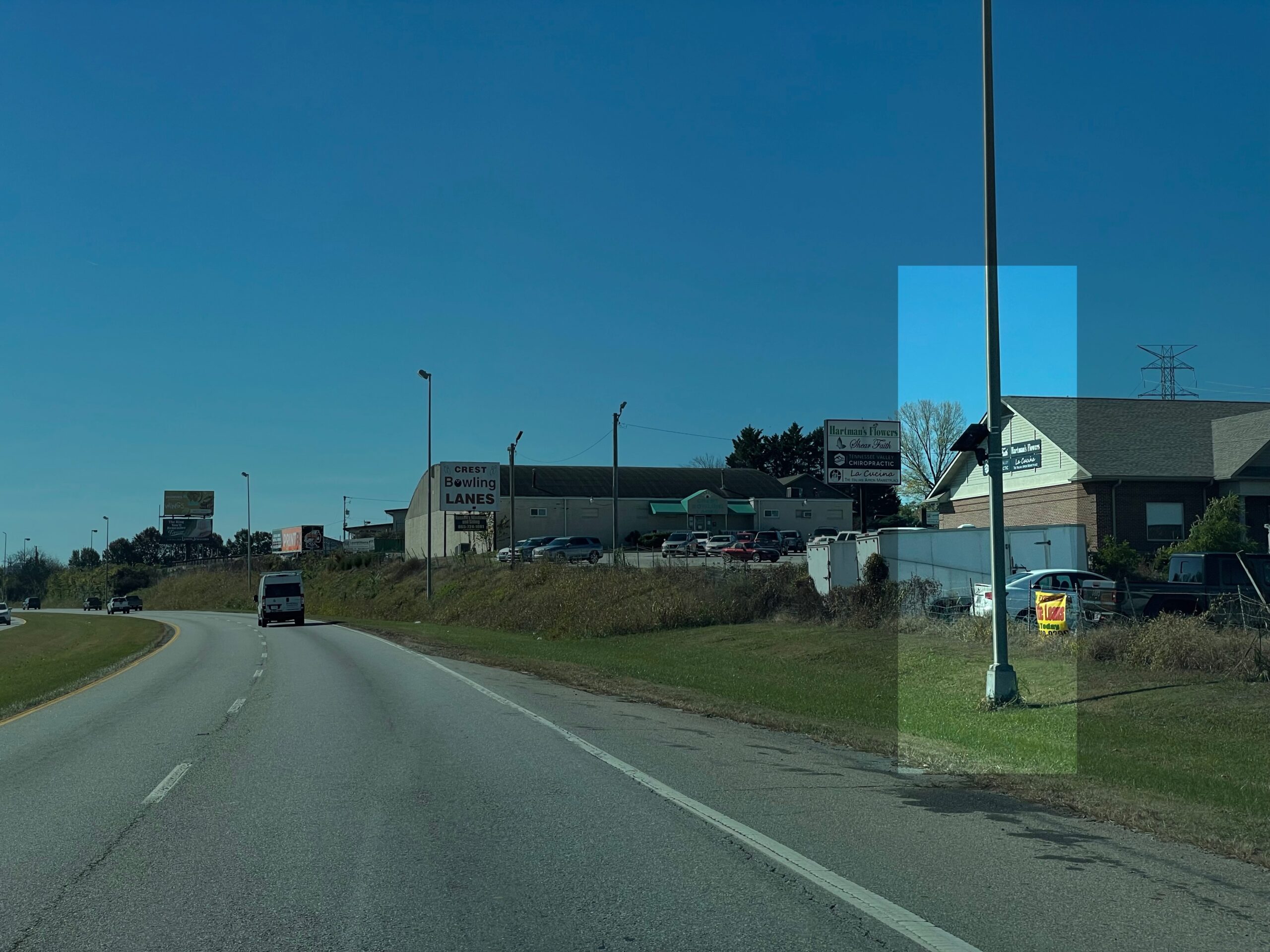
That matters locally because cameras are visible beside ordinary shopping and travel destinations around Maryville and Alcoa. These field photographs show how easily camera coverage can overlap with the places residents visit every day.
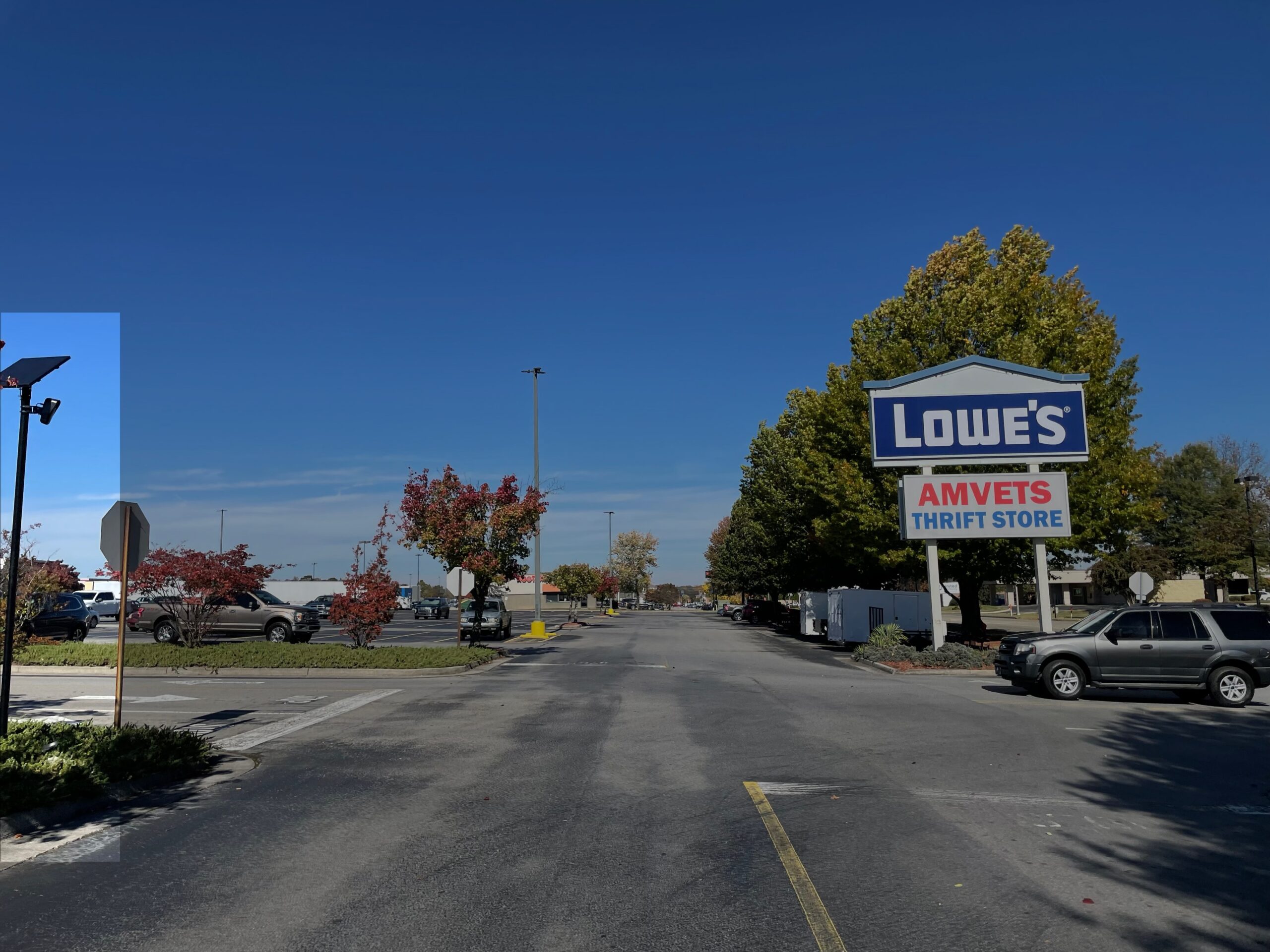
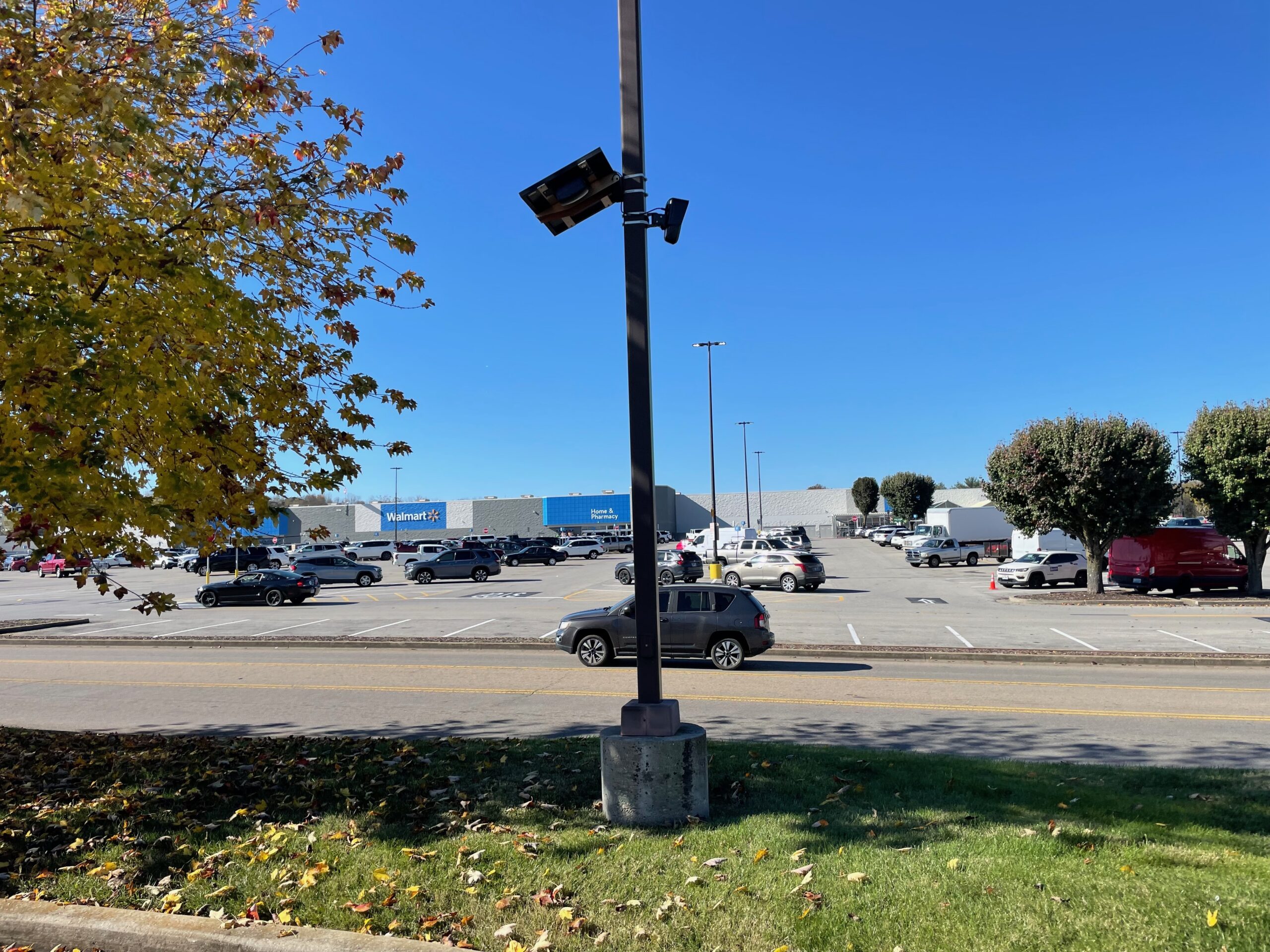
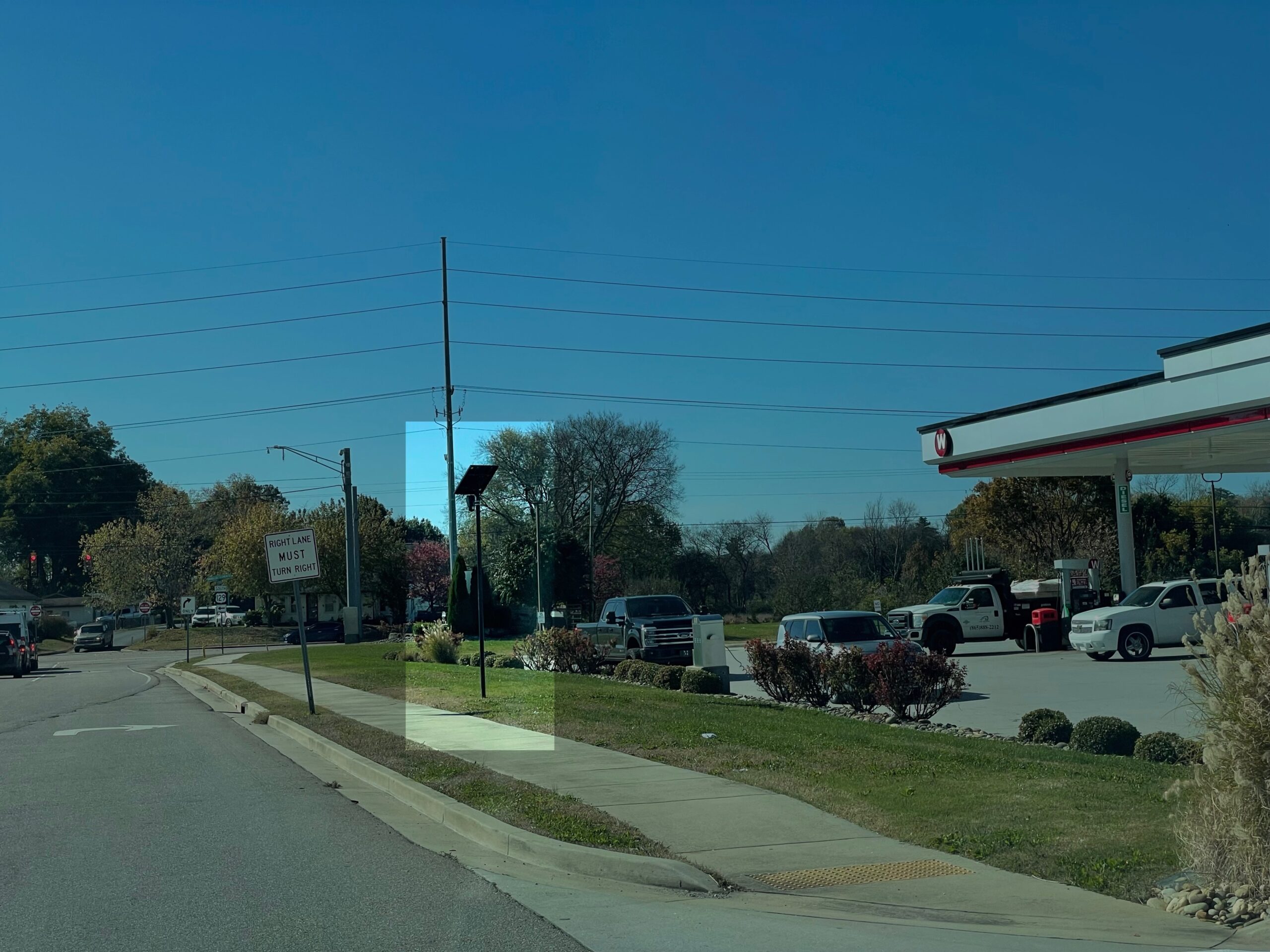
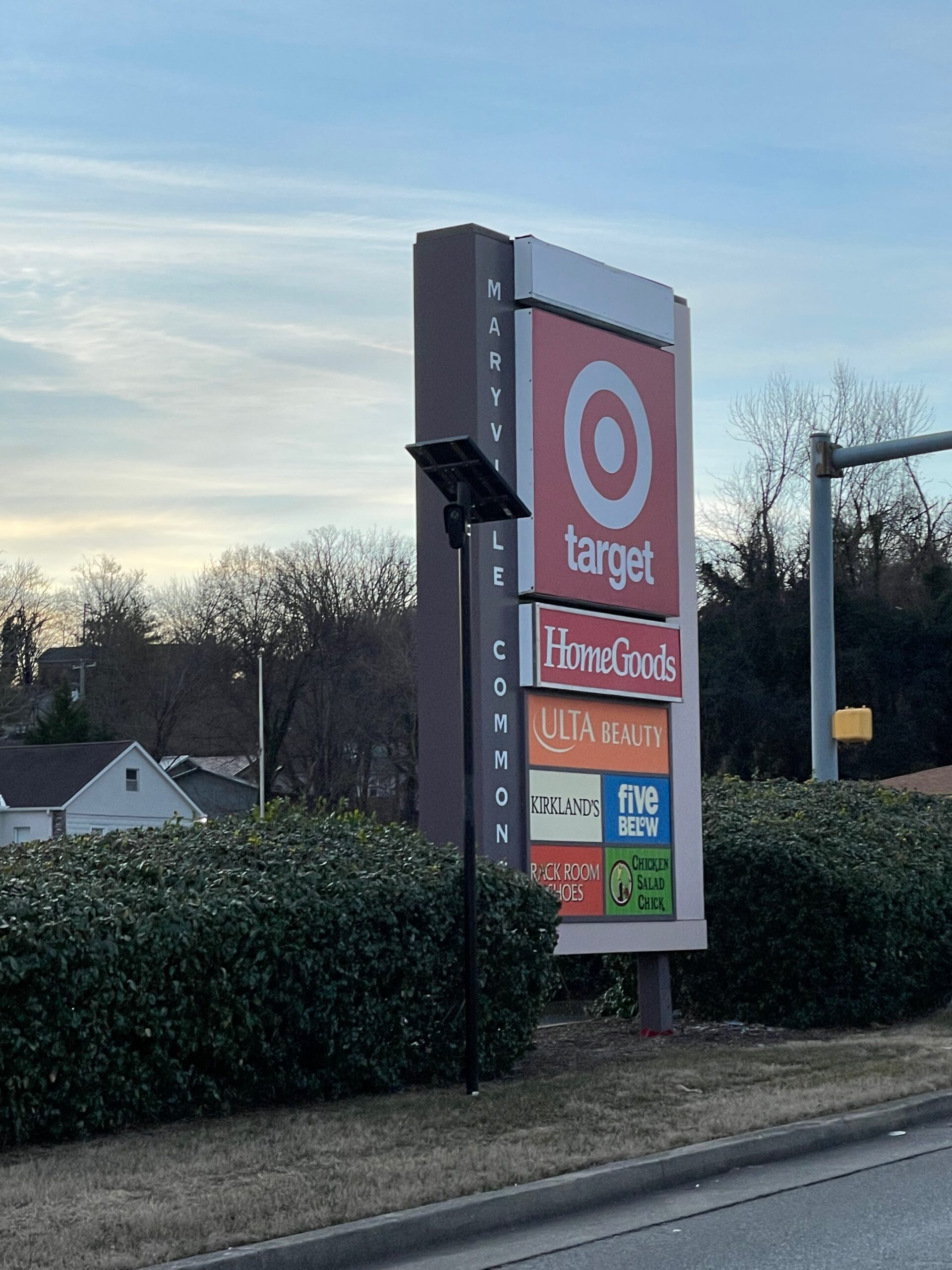
These photographs document camera installations near major Maryville and Alcoa shopping destinations. A camera’s physical location does not by itself establish that the nearby retailer owns it, operates it, or grants access to its data. MaryvillePrivacy.org is documenting the locations separately from ownership, contracts, and data-sharing relationships.
The Retail Connection Is Already Documented Nationally
Public records reported by the Electronic Frontier Foundation and 404 Media showed a Texas sheriff’s office could access Flock cameras at 173 Lowe’s locations nationwide, along with cameras and other Flock devices at dozens of Home Depot locations in Texas.
That national reporting does not prove that the specific Hunters Crossing Lowe’s camera photographed above is owned by Lowe’s or shared under the same arrangement. It does show why identifying the owner and access permissions of local cameras matters.
Why the Private Side Matters
The visible Maryville police cameras are only part of the surveillance picture. The larger oversight question is how many public and private collection points can create searchable vehicle-location data, who can access that data, and what rules govern that access.
Sources: Flock Safety; 404 Media / EFF retail-camera investigation. Local field photographs and confirmed locations are also being added to the Maryville Flock Camera Map.
Why This Record Raises a Stewardship Concern
A good steward of constitutional rights does not merely ask whether a vendor will sell a tool or whether a tool might help solve a case. A good steward asks what power the tool creates, how it can be abused, what limits are required, what records must be kept, what the public must be told, and what safeguards should exist before the tool goes live.
The documented record raises five stewardship concerns:
|
1. No written search policy
No produced policy explains who may search the system, what justification is required, whether searches are reviewed, or whether supervisor approval is needed.
|
|
2. No public audit structure
Residents are asked to trust the system without routine public reporting of searches, reasons, agency access, misuse reviews, or disciplinary referrals.
|
|
3. No Safe List policy
Public records show a hidden Safe List or exempt list issue, but no produced policy explains who may add plates, why, for how long, or under what oversight.
|
|
4. Vendor relationship boundaries were not written down
The record includes vendor events, a vendor lunch, hospitality questions, HUD grant facilitation, and direct product-expansion pitches, yet no written vendor meals, gifts, travel, or hospitality policy has been produced.
|
|
5. Commitment came before public understanding
As the procurement sequence above documents, the vendor was appointed and the state application signed weeks before the Council voted, and before residents received a full public explanation of what the system does, what data it creates, and how broadly that data may be shared.
|
Bottom line: Chief Crisp did not merely inherit a mature, tightly regulated system. The documented record indicates his department helped bring the system to Maryville, committed the City to it before the public was asked, operated it, expanded the vendor relationship, and did so without the written constitutional guardrails residents should expect.
A Constitutional Stewardship Standard for ALPR Systems
MaryvillePrivacy.org’s position is straightforward: if the government wants to search historical location data on ordinary residents, the default rule should be a warrant, individualized suspicion, written policy, narrow access, short retention, and public audit reporting.
| Warrant for retroactive searches | Searches of historical travel data should require judicial approval unless a clearly defined emergency exception applies. |
| Supervisor approval | Searches should require a documented reason and supervisory signoff before access, not merely after-the-fact discovery of misuse. |
| Retention limits | Data on ordinary drivers should not be retained longer than necessary, and retention should be set by law, not vendor preference. |
| Local control over sharing | Residents should know which agencies can access local data, for what purpose, and under what written agreements. |
| Public audit reports | The public should receive regular reports showing search volume, agency access, hotlist alerts, misuse investigations, and policy violations. |
These are not anti-police rules. They are pro-Constitution rules. They allow law enforcement to investigate actual crime while preventing a private vendor database from becoming a general-purpose tracking system for the innocent.
One Chief. One Vendor. One Surveillance Network.
|
“Public poles. Public money. Private database.” Maryville taxpayers paid for the system. Flock Safety owns the data platform. Chief Crisp signed the city up. |
|
“Crisp’s cameras don’t know you’re innocent.” The Maryville system records every passing driver, suspect or not. The innocent are captured first, sorted later. |
|
“Innocent in Maryville. Tracked in thousands of cities.” Plate reads captured in Maryville are searchable by agencies far outside Maryville, with no Maryville Police Department written policy governing how. |
|
“Built by Crisp. Hosted by Flock. Searched without a warrant.” No produced policy requires a warrant or even supervisor signoff for retrospective searches of Maryville-collected data. |
|
“The Fourth Amendment does not end at your property line.” Driving to work in Maryville should not generate a permanent, government-accessible profile in a private vendor database. |
Tony Crisp did not inherit this system. He helped bring it in, committed the City to it before the public was asked, helped expand it, and helped pitch additional Flock products on top of it, all without producing the written constitutional guardrails a responsible steward would put in place first. That is the public record. That is the Crisp Network.
Ten Fourth Amendment Questions the Program Still Raises
The 2026 campaign is over, but the program is not. These questions were first posed to Chief Crisp as a candidate and went unanswered before the August 6, 2026 primary. They are now addressed to him as Maryville’s sitting Police Chief and Director of Public Safety, because the system they concern is still running and still his to govern. This page will publish or summarize any written response received.
- Do you believe Maryville residents have a Fourth Amendment interest in their historical travel patterns captured by Flock Safety cameras?
- Why did Maryville operate Flock without a produced written policy governing who may search the system and under what justification?
- Why has Maryville not required supervisor approval before ALPR searches?
- Will you publish a complete ALPR search policy?
- Will you publish annual audit statistics showing searches, users, agency access, hotlist alerts, rejected searches, and misuse investigations?
- Who may place a license plate on Maryville’s Safe List or exempt list, for what reason, and under what written authority?
- Why was Flock Safety designated the City’s agent and preferred contractor, and the state application signed and certified, weeks before the City Council voted and with no public hearing?
- What written policy governed vendor meals, hospitality, travel, lunches, grant facilitation, and direct product pitches from Flock Safety?
- Will you commit to seeking City Council review, in public session, of retention limits, out-of-state agency sharing, and private-party access to Maryville-collected data?
- Do you consider a privately hosted, government-accessible location database built from public-road travel to be consistent with the spirit of the Fourth Amendment?
During the 2026 campaign, MaryvillePrivacy.org maintained a detailed voter-facing record examining Chief Crisp’s candidacy alongside his Flock program: the full vendor-email chronology, the vendor-hospitality questions, the HUD grant facilitation, the $300,000 to $600,000 drone pitch, the Critical Tech Solutions campaign contribution and marketing use of the Chief’s name, and the “two full-time jobs 200 miles apart” analysis. That page concluded with the August 6, 2026 primary and is preserved as a dated historical record.
Primary Sources and Related References
- Procurement sequence documents: Flock engineering/site plans (April 22, 2024), Authorization of Agent (May 24, 2024), TDOT application (May 31, 2024), MED Notice to Attach, City Council Resolution 2024-14 (July 2, 2024), and the TDOT license agreement (Request No. 7419, November 2024). All linked in the “How the Network Was Put in Place” section above.
- Primary election result and finance: Tennessee Secretary of State county breakdown and Who Funds Tennessee candidate pages, linked in the election-result section above.
- Archived 2026 campaign record: What District 8 Voters Were Shown About Maryville’s Flock Safety Program.
- Maryville Flock Safety Transparency Portal: transparency.flocksafety.com/maryville-tn-pd.
- Operational analytics dashboard: Flock Safety operational analytics dashboard for Maryville PD, reporting window beginning October 18, 2024, released under TPRA. View dashboard image.
- Drone emails and pricing: Re: Flock Drones email thread and official quote and map.
- Flock Nova product page: flocksafety.com/products/flock-nova.
- 404 Media on Nova plates-to-people linkage: 404 Media, May 14, 2025.
- WIRED on OS Investigate / Nightshift: “Flock Has a Powerful New AI Tool for Police. We Got Its Code,” WIRED, August 19, 2026. Full breakdown on the Who Is Flock Safety? page.
- Flock Safety response on dark-web data: Flock Safety blog, May 30, 2025.
- Independent code analysis (disputed by Flock): nexanet.ai, December 2025.
- EFF and 404 Media on Lowe’s / Home Depot Flock cameras: 404 Media, August 7, 2025.
- ACLU overview of Flock expansion concerns: ACLU, October 17, 2025.
- Constitutional cases: Riley v. California, 573 U.S. 373 (2014); Carpenter v. United States, 585 U.S. ___ (2018).