This page is a historical record of the 2026 Tennessee House District 8 campaign, which concluded on August 6, 2026. Chief Tony Jay Crisp lost the Republican primary to Jordan Henderson, 37.6 percent to 62.4 percent. The candidacy-specific material on this page, including the “two jobs 200 miles apart” analysis and the questions posed to the candidate before the primary, is preserved here as it stood during the campaign and is no longer being updated. Chief Crisp remains Maryville’s Police Chief and Director of Public Safety, and the Flock Safety program documented here is still in operation. For the current, primary MaryvillePrivacy.org record of that program, including the procurement sequence and the ongoing Fourth Amendment accountability questions, see: Tony Crisp’s Private Mass Surveillance Network →
Public Infrastructure, Private Surveillance: The Maryville PD–Flock Safety Vendor Relationship
A primary-source review of records released under the Tennessee Public Records Act documenting the relationship between the Maryville Police Department and Flock Safety, the constitutional concerns that relationship raises, and the questions Maryville voters and Tennessee state legislators are entitled to ask.
Tony Crisp Lost the District 8 Republican Primary
In the August 6, 2026 Republican primary for Tennessee House District 8, Maryville Public Safety Director Tony Jay Crisp was defeated by Jordan Henderson. Henderson, a Maryville native, former police officer, and Air National Guard veteran, won by roughly 25 points.
The result did not follow the money. According to filings with the Tennessee Registry of Election Finance, compiled by Who Funds Tennessee, Crisp raised about $148,063 and spent about $140,231, with roughly 83 percent of that spending on advertising and media. Henderson raised about $68,179 and spent about $47,768. Crisp raised more than twice what Henderson raised and spent close to three times as much, ran signs across the district and paid for advertising on television and YouTube, and still lost by about 2,300 votes.
This page documents Chief Crisp’s record as the official most associated with bringing Flock Safety mass surveillance to Maryville, expanding it through a direct vendor relationship, and, in his own emails released under the Tennessee Public Records Act, working to help the vendor’s sales representative reach additional funding and additional sales. The primary result means that record will not be carried into the Tennessee General Assembly, where the District 8 seat helps write the state laws that govern exactly this technology. For residents concerned about the Fourth Amendment questions this page raises, that is a meaningful outcome.
MaryvillePrivacy.org does not claim to know why voters decided as they did, and does not claim credit for the result. A primary is decided by many things at once: the candidates themselves, name recognition, local ties, turnout, and issues that have nothing to do with surveillance. What this site can say is narrow and documented: the public record on this page was available to any District 8 voter who went looking, and the candidate who built and expanded Maryville’s surveillance program did not win the seat.
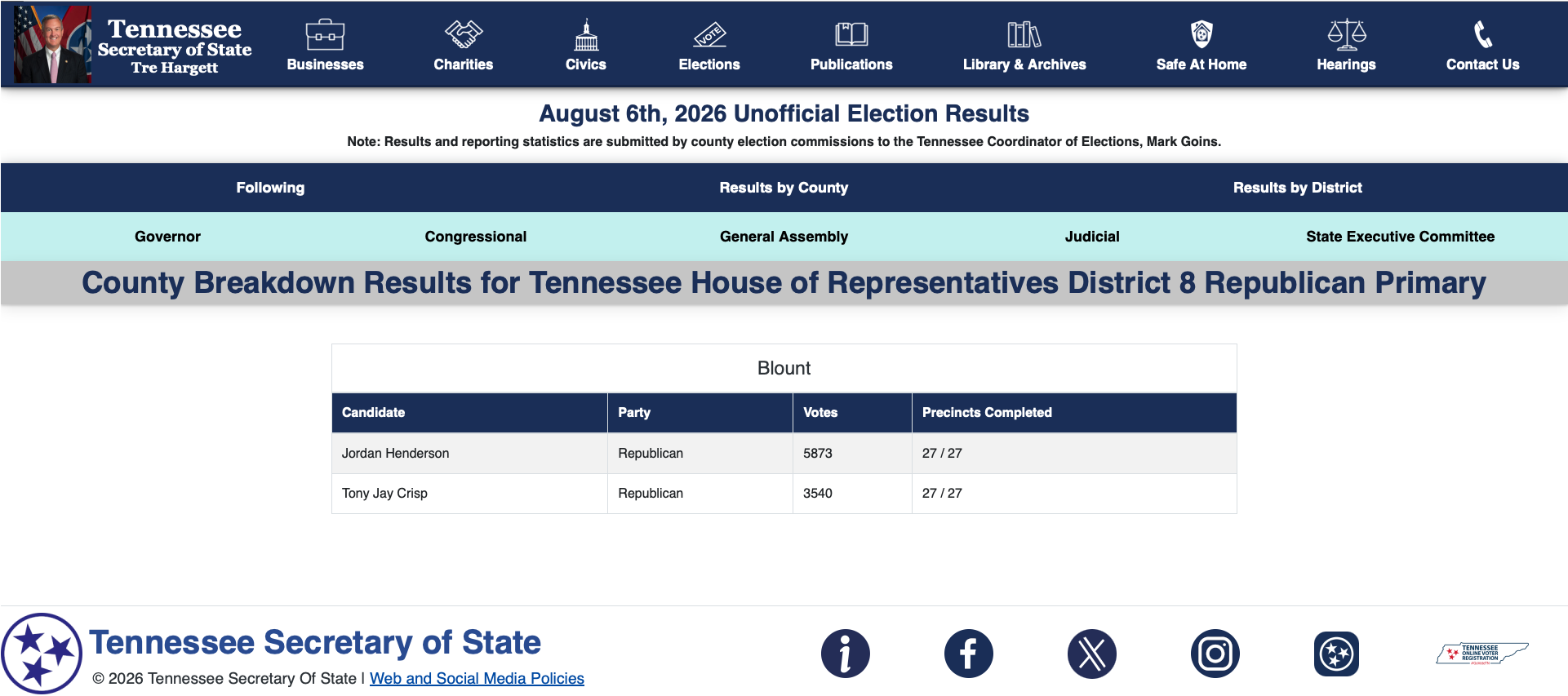
Full campaign-finance detail for both candidates, compiled from Tennessee Registry of Election Finance filings:
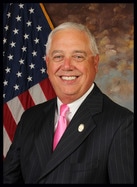
Tony Jay Crisp (image) ·
Jordan Henderson (image).
Sources: County-by-county results reported by the Tennessee Secretary of State for the Tennessee House District 8 Republican primary, August 6, 2026 (unofficial pending certification); Who Funds Tennessee candidate pages for Tony Jay Crisp and Jordan Henderson, compiled from Tennessee Registry of Election Finance filings through the Pre-Primary 2026 report dated July 30, 2026.
Maryville Police Chief Tony Jay Crisp is currently a candidate for the Tennessee House of Representatives. According to the Tennessee Secretary of State’s Petitions Filed for Tennessee House of Representatives list dated March 12, 2026, Chief Crisp filed as a Republican candidate for Tennessee House District 8, which covers part of Blount County including parts of Maryville and Alcoa, all of Townsend and Walland, and a portion of the Great Smoky Mountains National Park. The Republican primary will be held on August 6, 2026. The general election will be held on November 3, 2026. Chief Crisp’s filing places his record as a city department head, including his stewardship of the city’s Flock Safety mass surveillance program, directly within the legitimate scope of public review by Tennessee voters.
The candidate’s official campaign website is tonycrispforstatehouse8.com; his campaign Facebook page is listed here. The official Tennessee General Assembly member page for District 8 is available here.
The documented concerns summarized on this page have been provided to the City of Maryville and to the State of Tennessee for review.
Those concerns involve public records documenting vendor access to Maryville Police Department leadership, vendor hospitality questions, no-competitive-bid surveillance procurement pathways, campaign contributions from a surveillance-technology vendor with an existing Maryville PD relationship, use of the Chief’s name and the Department’s identifier in vendor marketing, and the absence of written policies governing both ALPR surveillance operations and vendor relationships.
No response received from any addressed City of Maryville official or outside legal counsel before, on, or after the published comment deadline. This section will be updated if and when a response is provided.
In May 2026, MaryvillePrivacy.org sent a formal Request for Comment by email with the subject line “Request for Comment Regarding Police Vendor Marketing and Campaign Contribution,” addressed to the Mayor, Vice Mayor, City Manager, City Recorder, and outside legal counsel of the City of Maryville. The email asked five specific questions concerning Maryville Police Department leadership and Critical Tech Solutions / Propel Ops LLC, the Knoxville-based surveillance-equipment vendor that has contributed to Chief Crisp’s state legislative campaign and that publicly uses the Chief’s name and the Department’s identifier in its sales marketing.
The email stated a publication deadline of 5:00 p.m., Friday, May 15, 2026, and offered to publish or link any comment, clarification, correction, or responsive policy document received before that time. No such material was received from any addressed party.
| Name | Public Role | |
| Andy White | Mayor | awhite@maryville-tn.gov |
| Fred Metz | Vice Mayor | fmetz@maryville-tn.gov |
| Greg McClain | City Manager | gmcclain@maryville-tn.gov |
| Sherri Phillips | City Recorder | sphillips@maryville-tn.gov |
| Melanie E. Davis | Outside Legal Counsel (Kizer & Black, Attorneys, PLLC) | mdavis@kizerblack.com |
Roles confirmed against the City of Maryville official website at maryvillegov.com/city-council-members. According to her public attorney biography, Melanie E. Davis of Kizer & Black has represented the City of Maryville since 1999 in the capacity of outside counsel, including the City Council, the Planning Commission, the Board of Zoning Appeals, and the City School Board.
A separate report describing the documented vendor-relationship and procurement concerns has been submitted to the Tennessee Comptroller of the Treasury’s Fraud, Waste, and Abuse reporting portal at comptroller.tn.gov/office-functions/investigations/fraud-waste-and-abuse.html. The Comptroller’s Office has operated this hotline since October 1983 for the reporting of suspected fraud, waste, or abuse of government funds and property by state agencies, municipalities, counties, and entities receiving public funds. MaryvillePrivacy.org has filed this referral as an ordinary act of civic reporting and does not allege any specific finding of misconduct. Any acknowledgment, response, or further communication from the Comptroller’s Office will be reported on this page.
Read the full text of the Request for Comment
Subject: Request for Comment Regarding Police Vendor Marketing and Campaign Contribution
To: awhite@maryville-tn.gov; fmetz@maryville-tn.gov; gmcclain@maryville-tn.gov; sphillips@maryville-tn.gov; mdavis@kizerblack.com
Mayor White,
MaryvillePrivacy.org is preparing an update regarding the Maryville Police Department’s relationships with private surveillance vendors and wanted to give the City an opportunity to comment before publication.
Public campaign-finance records list a $1,000 contribution to Chief Tony Jay Crisp’s state legislative campaign from Propel Ops LLC d/b/a Critical Tech Solutions. Critical Tech Solutions appears to sell surveillance equipment to law enforcement and government agencies, advertises cooperative purchasing / no-competitive-bid procurement pathways, features the Maryville Police Department in a customer story, quotes Lt. Rod Fernandez, and displays Chief Crisp’s name and the Maryville Police Department identifier in its sales marketing.
Given Chief Crisp’s role as Maryville Police Chief and Public Safety Director, MaryvillePrivacy.org is requesting the City’s comment on the following:
- Did the City authorize Critical Tech Solutions to use Chief Crisp’s name and the Maryville Police Department identifier in its sales marketing?
- Did any City or Maryville Police Department employee review or approve the testimonial or customer-story language before publication?
- Has Maryville purchased, leased, tested, borrowed, or deployed any equipment or services from Critical Tech Solutions / Propel Ops LLC from January 1, 2022 to present? If so, through what procurement process?
- Does the City view a vendor’s campaign contribution to the sitting police chief, while also using the chief and department in marketing materials, as a potential conflict of interest or public-integrity concern?
- Does Maryville have any written policy governing vendor testimonials, vendor marketing use of city personnel or department names, vendor gifts and hospitality, or campaign contributions from vendors seeking or holding city business?
MaryvillePrivacy.org does not allege criminal wrongdoing. The concern is public integrity, vendor access, procurement transparency, and whether private surveillance vendors are using city officials or city departments to advance commercial sales while also financially supporting a candidate for state office.
MaryvillePrivacy.org intends to publish the update after 5:00 p.m. on Friday, May 15. Any comment, clarification, correction, or responsive policy document received before then will be included or linked in the article.
Respectfully,
MaryvillePrivacy.org Editorial Team
A Local Citizen Project Promoting Transparency in Public Safety Technology
Maryville, Tennessee
www.MaryvillePrivacy.org · info@maryvilleprivacy.org
📷 What Happens When You Drive Past One of These Cameras
When any vehicle passes a Flock Safety camera, the following happens automatically, in fractions of a second:
- A photograph is taken of the vehicle.
- The license plate is read by AI character recognition.
- The make, model, and color of the vehicle are identified.
- A timestamp and the camera’s location are added.
- The full record is uploaded to a private database hosted out of state by a private company.
- The record becomes searchable, including in retrospect, by Maryville Police Department personnel and by hundreds of other police agencies across the country who have access-sharing arrangements with the system.
This happens to every driver who passes a Flock camera. It happens whether the driver is suspected of any offense or not. It happens whether the driver lives in Maryville or is passing through. It happens without a warrant. It happens without notice. The system does not distinguish between someone running an errand and someone fleeing a crime. Every vehicle is recorded the same way and added to the same searchable database.
Maryville’s Flock Safety Transparency Portal confirms that 310,458 license plates were captured in a recent 30-day window, a figure the system reports as approximately 10,000 plates per day passing through 16 cameras. The overwhelming majority of those plates belong to drivers who are not suspected of any wrongdoing whatsoever.
A Note on What “310,458 Plates” Actually Means
The transparency portal figure is a deduplicated count: a vehicle photographed many times by multiple cameras on the same day still counts as one captured plate for reporting purposes. The actual capture volume documented in the City’s own operational data is roughly an order of magnitude higher.
An operational analytics dashboard produced by Flock Safety for the Maryville Police Department, and released to MaryvillePrivacy.org in 2024 in response to a Tennessee Public Records Act request, shows the actual capture activity for the 26-day period from October 18 to November 12, 2024:
- Approximately 3.3 million capture events across the 16-camera network in 26 days.
- Approximately 127,000 captures per day on average. The portal’s headline number is roughly one-tenth of this.
- 2,952,335 captures of Tennessee-plated vehicles in those 26 days, or approximately 113,500 captures of TN-plated drivers per day.
- Out-of-state captures are dominated by Georgia (30,523), Florida (28,514), North Carolina (14,510), and Texas (12,014) plates: regional and Smoky Mountains-bound visitors, not the demographic of “wanted criminals” the system is publicly justified to address.
- Top captured vehicle types: SUV (1,188,930), Sedan (576,325), Pickup (553,668). Top captured makes: Toyota (66,991), Ford (66,026), Honda (48,345), Nissan (42,336), Jeep (22,165). The system’s daily catch is overwhelmingly mainstream consumer vehicles driven by ordinary residents.
- Time-of-day capture patterns peak at the hours of school dropoff, the workday commute, and the workday evening return. The system’s heaviest activity tracks the routine movement of working families, not criminal flight patterns.
A regular Maryville resident whose daily routes pass multiple cameras is photographed and added to the database every time they pass each camera, every day. Over the course of a month, an active local driver may be captured dozens to hundreds of times across the 16-camera network. The result is a private out-of-state database that does not record isolated public movements. It records life patterns: the route from home to work, the school dropoff and pickup, the church on Sunday, the medical appointments, the grocery runs, the visits to family.
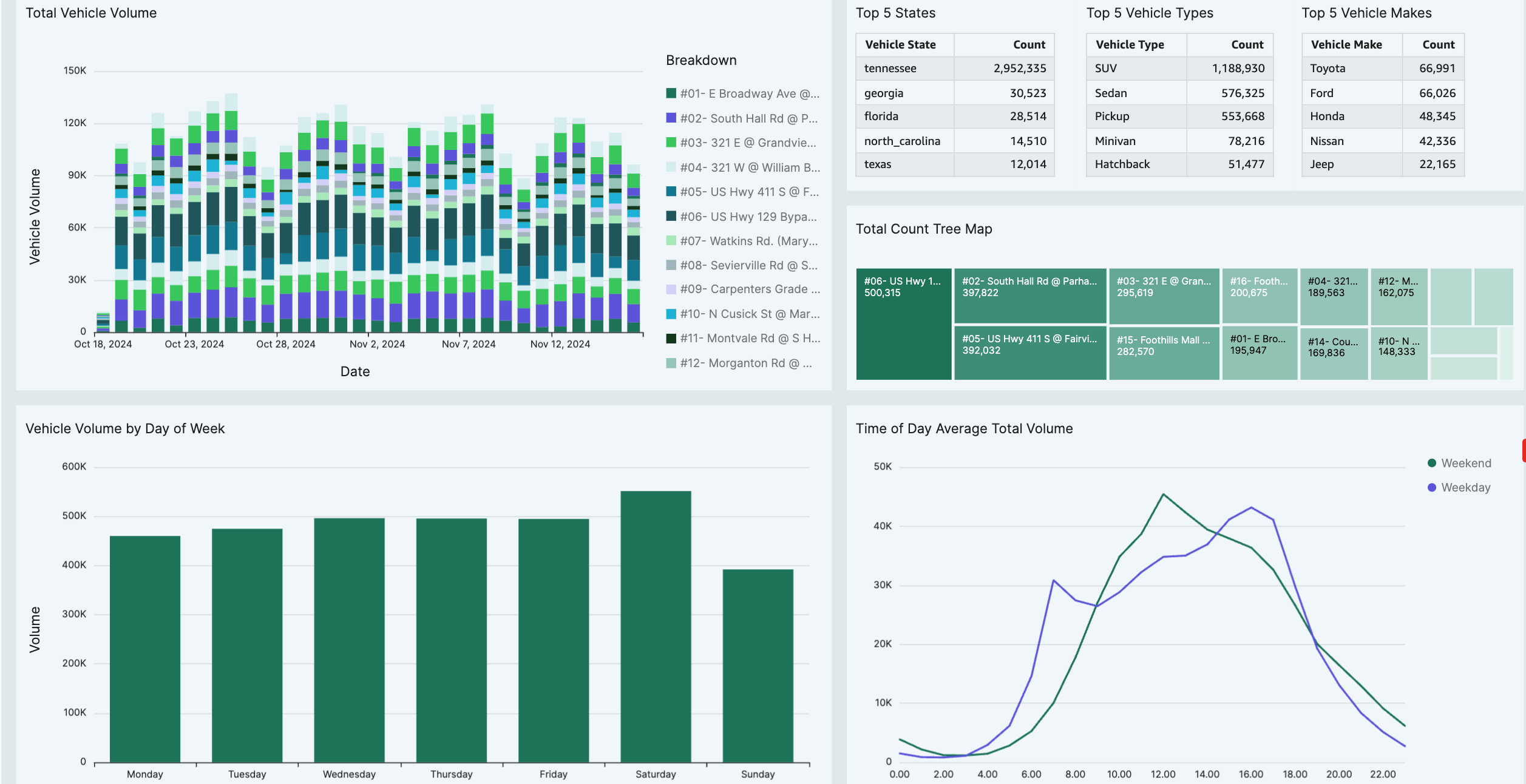
Source: Flock Safety operational analytics dashboard for Maryville Police Department, period October 18 to November 12, 2024, released by City of Maryville under the Tennessee Public Records Act.
📅 The Documented Order of Events
Records from the City of Maryville, Flock Safety, and the Tennessee Department of Transportation document the order in which Maryville’s ALPR program was actually decided. Before the City Council voted, Flock had already drawn site-specific engineering plans for a Maryville installation, Chief Crisp had designated Flock Safety as the City’s agent and preferred contractor, and Crisp had signed and certified the City’s application to the State to install cameras in state right-of-way. The elected body did not act until July 2, 2024, and it acted with no public hearing.
| Feb. 27, 2024 | Flock Safety sales representative Alex Guth emails Chief Crisp inviting him to a 3-day vendor conference at Loews Atlanta. |
| March 1, 2024 | East Tennessee Regional Flock Safety Deep Dive training in Sevierville, TN. Invitation sent to Chief Crisp’s official municipal email account. |
| March 20, 2024 | In-person vendor meeting at the Maryville Police Department. Lt. Fernandez attends in the Chief’s place. |
| April 22, 2024 | Flock Safety prepares preliminary engineering and site plans for a specific Maryville ALPR installation on W. Lamar Alexander Parkway, titled “on behalf of Maryville Police Department” for TDOT permitting (Case No. 590786). More than two months before the City Council vote. |
| May 24, 2024 | Chief Crisp signs an “Authorization of Agent” naming Flock Safety as the City’s agent to apply for the state permit and as the Department’s “preferred contractor.” More than five weeks before the City Council vote. |
| May 31, 2024 | Chief Crisp signs and certifies the City’s TDOT application to install ALPR cameras in state right-of-way. The application form itself requires local legislative approval before submitting; the Council does not vote until July 2. |
| May 31, 2024 | On the same day, Lt. Fernandez’s letter to the Maryville Electric Department requests permission to mount Flock cameras on city utility poles. The pole attachment is later approved by MED as a solar-powered “Notice to Attach.” |
| July 2, 2024 | City Council vote authorizing the Flock Safety program. No public hearing was held before the vote. Residents had not been informed of the system’s full capabilities, the data-sharing relationships with hundreds of out-of-state agencies, the absence of written policies governing how the system would be operated, or the months-long vendor relationship between the Chief and the sales representative that preceded the vote. |
| Nov. 11, 2024 | Additional camera subscription quotes (Falcon and Falcon Flex) issued to Maryville PD by Flock Group Inc. |
| Feb.–March 2025 | Vendor asks Chief Crisp to facilitate HUD grant connection that would expand Flock Safety sales to the Maryville Housing Authority. Chief agrees to facilitate. |
| March–April 2025 | Vendor pitches multi-jurisdictional drone-as-first-responder program at $300,000 to $600,000 annually, negotiated directly with Chief Crisp. The vendor’s email opens with “Thank you for the hospitality last week. It was a blast!” No competitive bid process or RFP is documented in the public record. |
The chronology shows that Maryville’s Flock Safety program was not the result of public demand, a community planning process, or a competitive procurement. It was the result of a vendor relationship that began with a sales pitch directed at the Chief of Police, that produced operational decisions (including the May 2024 pole-mounting request to the Electric Department) before residents were informed the system was being considered, and that has continued to expand through the same direct vendor-to-Chief channel since the program’s authorization.
📄 Committed to the Vendor and the State Before the Council Voted, and Before Any Resident Was Asked
Before the Maryville City Council ever voted, the vendor had been appointed and the state application had been signed. Flock had drawn preliminary site-specific engineering plans for a Maryville installation by April 22, 2024. Chief Crisp designated Flock Safety as the City’s agent and preferred contractor on May 24, and signed and certified the City’s application to the State on May 31. The City Council did not act until July 2, 2024, and it acted with no public hearing.
|
April 22, 2024
Site-specific engineering plans already drawn.
Flock Safety prepares a preliminary engineering plan set for an ALPR installation on W. Lamar Alexander Parkway, drawn “on behalf of Maryville Police Department” for TDOT permitting, with pole locations, coordinates, and camera specifications. The project is already at the permit-drawing stage.
|
|
May 24, 2024
Vendor designated as the City’s agent and preferred contractor.
On Maryville Police Department letterhead, Chief Crisp signs an “Authorization of Agent” naming Flock Safety as the City’s agent to apply for the Tennessee DOT encroachment permit and “act on my behalf,” and as the Department’s “preferred contractor” to perform the work. No competitive process precedes this designation.
|
|
May 31, 2024
State application signed and certified by the Chief.
Chief Crisp signs the City’s TDOT application to install and operate ALPR cameras in state right-of-way, certifying the information “true and accurate” as Chief of Police, under the statute cited on the form, Tenn. Code Ann. section 55-8-198(f).
|
|
July 2, 2024
Council votes, with no public hearing.
Resolution 2024-14 endorses and approves the installation, more than five weeks after the agent authorization and the signed state application. Its own text describes the Department as having “for numerous years operated LPR/Cameras,” framing the vote as blessing an existing practice. No public hearing was held.
|
|
November 7 to 11, 2024
State license executed for ten years.
Chief Crisp signs a TDOT license running November 7, 2024 to November 6, 2034, at a $0 annual fee to the State, binding the Maryville Police Department for ten years.
|
What the state’s own application required
The TDOT application form sets out its own order of operations. In the note for local law enforcement applicants, it states that the applicant must obtain, and provide documentation of, the local legislative body’s approval of the proposal “before submitting the application to TDOT.” The application was signed and certified on May 31, 2024. The City Council did not vote until July 2, 2024, more than five weeks later.
Read together, the records show the substantive decisions were made before the public body acted and before the public was told. By July 2, the vendor had already been designated as the City’s agent and preferred contractor, the state application had already been signed and certified, and the elected body’s role was reduced to endorsing a program that was already in motion. No public hearing was held. No resident was notified. No public meeting was held to take community input.
The question the record raises: the issue is not only whether each step was lawful. It is whether the decision to place a city’s entire driving public under continuous automated surveillance should be set in motion by one official signing forms, weeks before the elected council votes, and without a single resident being asked.
📄 Primary Source Documents
- Flock Safety preliminary ALPR engineering and site plans, “on behalf of Maryville Police Department,” dated April 22, 2024 (PDF)
- Maryville Police “Authorization of Agent” naming Flock Safety, signed by Chief Crisp, May 24, 2024 (PDF)
- Maryville TDOT ALPR application, signed and certified by Chief Crisp, May 31, 2024 (PDF)
- Maryville Electric Department “Notice to Attach,” approving pole attachment for the Flock cameras (PDF)
- Maryville City Council Resolution 2024-14, July 2, 2024 (PDF)
- TDOT ALPR license agreement, Request No. 7419, signed by Chief Crisp and executed by the State, November 2024 (PDF)
Sources: Flock Safety preliminary ALPR engineering and site plans, “on behalf of Maryville Police Department,” dated April 22, 2024; Maryville Police Authorization of Agent (May 24, 2024); Maryville TDOT ALPR application signed by Chief Crisp (May 31, 2024); Maryville Electric Department Notice to Attach; Maryville City Council Resolution 2024-14 (July 2, 2024); TDOT ALPR license agreement, Request No. 7419, signed by Chief Crisp and executed by the State in November 2024. All linked above.
Tony Crisp’s Private Mass Surveillance Network
This page documents the vendor relationship and public-record trail. A companion page explains the constitutional issue in plain language: public roads, public poles, public money, private database, government access, no warrant, no notice, and no produced written search policy.
The Fourth Amendment does not end at your property line. The First Amendment does not protect speech only inside your living room. The Second Amendment does not apply only while standing on your own property. The Fourth Amendment should not be treated as if ordinary residents lose constitutional protection the moment they drive down a public road.
⚖️ The Fourth Amendment Workaround Is the Whole Business Model
The Fourth Amendment requires the government to demonstrate individualized suspicion, supported by a warrant, before searching the private affairs of an American. That requirement has been a structural protection of personal liberty for over two centuries. Flock Safety’s business model is designed to operate around it.
The cameras are mounted on public utility poles, traffic standards, and right-of-way infrastructure that exists because taxpayers fund and maintain it. The license plates and vehicle metadata they capture are recorded automatically, without warrant or suspicion, on every car that passes. The resulting database is hosted privately by a vendor headquartered out of state, and access to that database, including search, retroactive lookup, multi-camera convoy analysis, and travel-history reconstruction, is sold back to the local government as a subscription product.
The legal theory the industry relies on is that data a citizen has “voluntarily” exposed to public view is no longer subject to a reasonable expectation of privacy, and that data acquired through commercial purchase from a private vendor is therefore not a “search” subject to the Fourth Amendment. That theory has been weakening since 2018.
Carpenter v. United States (2018): The Supreme Court held, in an opinion by Chief Justice Roberts, that the government’s warrantless acquisition of historical cell site location information from a phone carrier violated the Fourth Amendment. The Court rejected the older “third-party doctrine” idea that information shared with a third party automatically loses its constitutional protection. Carpenter is widely regarded as the controlling precedent for whether the same constitutional analysis applies to commercially aggregated location data acquired through ALPR vendors.
Lower courts have not yet definitively extended Carpenter to commercially aggregated ALPR data. The Institute for Justice currently has a federal lawsuit pending in Schmidt v. City of Norfolk challenging exactly this workaround. The Electronic Frontier Foundation has documented that some agencies and the data brokers themselves “did not believe the surveillance implicated Fourth Amendment rights and proceeded without warrants.”
Until the Supreme Court extends Carpenter to commercial location databases, residents in Maryville sit in a constitutional gap: the kind of mass location surveillance that would clearly require a warrant if conducted directly by the government is being conducted by a private vendor and sold back to the government as a service. Maryville’s Flock Safety Transparency Portal confirms 16 cameras, 30-day retention, 310,458 plates captured in a recent 30-day window, and shared access with hundreds of agencies nationwide. None of that requires a warrant. None of that requires individualized suspicion. The driver is not notified.
The local official who has been the most consistent advocate for expanding this system in Maryville is Chief Tony Jay Crisp, who is now also a candidate for state legislative office. The remainder of this page documents that relationship as it appears in records produced under the Tennessee Public Records Act.
Records released through the Tennessee Public Records Act document an ongoing relationship between the Maryville Police Department, principally Chief Tony Jay Crisp and Lt. Rod Fernandez, and Flock Safety, principally Alex Guth (Law Enforcement Sales, East TN/West NC). Each item below is supported by an attached primary-source PDF available on this site or through TPRA records. Quotes are reproduced from the vendor’s own emails and from Chief Crisp’s own replies.
- Feb. 27, 2024. Vendor invites Chief Crisp to a 3-day conference at Loews Atlanta.
- March 1, 2024. East TN regional vendor training in Sevierville.
- March 20, 2024. In-person vendor meeting with MPD command staff.
- 2024. Vendor-hosted lunch (“Flock Lunch – Small Town”).
- Feb. 17 to March 3, 2025. Chief agrees to facilitate vendor introduction to the Maryville Housing Authority for a HUD-grant-funded Flock sale.
- March 27, 2025. Vendor email opens “Thank you for the hospitality last week.”
- March to April 2025. Vendor pitches a $300,000 to $600,000 multi-jurisdictional drone program directly to the Chief. No RFP documented.
- Nov. 11, 2024. Active subscription quotes for additional Falcon and Falcon Flex cameras.
Each item is documented in full below with the underlying email, calendar entry, or budgetary quote.
📋 What These Records, Read Together, Actually Show
No single email or invitation, taken alone, would necessarily warrant public review. The records collectively, viewed in chronological order, document a different picture: a sustained, multi-year relationship between a single vendor representative and the senior leadership of a municipal police department, conducted largely without public visibility or formal procurement structure, that produced an expanding pipeline of public-funded surveillance contracts.
The pattern visible in the documented record:
- Hospitality flowed in both directions. The vendor invited department leadership to multi-day events at Loews Atlanta and to regional training in Sevierville. The vendor also recorded receiving hospitality from the chief in March 2025 (“Thank you for the hospitality last week”). The department has confirmed it has no written policy governing vendor meals, hospitality, or gifts.
- The chief was used as a sales facilitator. The HUD grant exchange shows the vendor explicitly asking the chief to leverage his municipal connections to drive additional Flock sales to a separate public agency. The chief agreed to do so.
- The product pipeline expanded continuously. Initial Falcon LPR cameras led to Falcon Flex tactical units, which led to a multi-jurisdictional drone-as-first-responder pitch at $300,000 to $600,000 per year, with a fixed-wing drone identified as the next step.
- Public competitive bid process is not evident in the record. Pricing for major expansions appears to have been negotiated directly between the vendor representative and the chief. The City has not produced a competitive RFP for the proposed drone program.
- The system itself operates without policies. Independent of the vendor relationship, the City of Maryville has confirmed in writing that it has no written policies governing who can search the Flock system, what justification is required, what supervision is in place, or under what authority license plates can be added to a hidden Safe List.
This is the pattern Maryville voters and Tennessee state legislators are entitled to evaluate when assessing Chief Crisp’s record as a candidate for state office. A representative who would carry this department’s vendor-relationship and policy posture into the Tennessee General Assembly would be in a position to vote on, propose, or block state-level legislation governing exactly the surveillance practices at issue here.
📋 What the Candidate Has Promised, and What the Record Shows
Chief Crisp’s official campaign website at tonycrispforstatehouse8.com lists six “Conservative Plan of Action” priorities. Three of those stated priorities have a direct bearing on the surveillance system Chief Crisp’s department operates and the way it has been operated. The comparisons below do not predict how Candidate Crisp would govern at the state level. They simply place his stated commitments alongside the documented record of his municipal department, and let voters draw their own conclusions.
These are not rhetorical questions. They are direct comparisons between the candidate’s own publicly stated commitments and the documented record of the department he has led. Either the stated priorities accurately describe how he would govern at the state level, or they do not. Voters in District 8 deserve a public answer from the candidate himself, in writing, before the August 6, 2026 primary.
🕒 One Person. Two Full-Time Public Jobs. Two Cities 200 Miles Apart.
Chief Tony Jay Crisp has publicly stated that if he is elected to the Tennessee House of Representatives, he intends to continue serving as Maryville’s Public Safety Director, the position under which he holds the titles of Police Chief and Fire Chief simultaneously.
That is not a hypothetical. It is a stated plan, and it is the single most concrete commitment the candidate has made about what he would do with the office if he wins it. The material below sets out what each of those two jobs actually requires, using the City of Maryville’s own published organizational structure and the Tennessee General Assembly’s own published calendar. No estimates are used where a published figure exists, and every estimate that appears is labeled as one.
A Public Safety Director who is in Nashville is not 20 minutes from the Maryville Police Department. He is most of a working day away from it. There is no version of this arrangement in which the person Maryville pays to command its police and fire departments can reach a Maryville scene, a Maryville emergency operations center, or a Maryville city hall meeting on short notice while the General Assembly is in session.
A week contains 168 hours. That number is fixed and it is the same for everyone. The table below allocates one session week. The hour figures in the middle column are illustrative estimates based on ordinary expectations for each role, clearly labeled as such. The dates, distances, salaries, and titles used elsewhere on this page are documented figures, not estimates.
| Obligation | Est. Hours | Located In |
| Floor sessions, committee meetings, caucus, constituent meetings | 35 to 45 | Nashville |
| Round-trip drive, Maryville to Nashville and back | 7 to 8 | Interstate 40 |
| Command of a municipal police department | 40+ | Maryville |
| Command of a municipal fire department | Additional | Maryville |
| Emergency availability as Public Safety Director | 24 / 7 | Maryville |
| Sleep, at seven hours per night | 49 | Somewhere |
| Hours available in a week | 168 |
The Point Is Not That the Arithmetic Is Impossible. The Point Is Which Job Loses.
It is technically possible to hold two positions at once by giving each one less than it needs. That is exactly the problem. Nobody adds a second full-time public job without subtracting from the first one, and in this case the first one is command of the police and fire departments that Maryville residents call when something has gone badly wrong.
During the 2026 session, the General Assembly convened on January 13 and adjourned on April 24. That is roughly 15 weeks in which a District 8 representative is expected in Nashville for floor votes, early-morning committee hearings, budget work, and caucus obligations. For those weeks, Maryville’s Public Safety Director would be running two emergency-response departments from 200 miles away, on a schedule set by someone else, in a city he cannot leave in the middle of a floor vote.
Maryville residents are not paying for a Public Safety Director who is available when the legislature is not in session. They are paying for a full-time Public Safety Director. The question this page puts to the candidate is straightforward: if the state job takes the hours, what happens to the city job the taxpayers are still funding?
|
Outcome One
The city job is performed at reduced capacity.
Maryville continues paying a full-time Public Safety Director salary for a position that is, for a substantial part of each year, filled from another city. Taxpayers fund a full-time role and receive a part-time one.
|
|
Outcome Two
The state job is performed at reduced capacity.
District 8 sends a representative to Nashville who is managing two emergency departments by phone during committee hearings, and who is competing for attention against 98 other members who are not doing a second full-time job.
|
|
Outcome Three
Both are performed at reduced capacity.
Two sets of taxpayers, city and state, each fund a public office in full and each receive a fraction of it. Neither set of taxpayers has been asked whether that is an acceptable arrangement.
|
There is no fourth outcome. A person cannot be in Maryville and in Nashville at the same time, and the hours in a week do not expand to accommodate a second job. Voters in District 8 are entitled to hear the candidate say plainly which of those three outcomes he is asking them to accept.
A Second Problem: The Same Person on Both Sides of the Table
The scheduling conflict is the visible problem. There is a structural one underneath it. A sitting Public Safety Director who is also a sitting state legislator would be voting in Nashville on the statutes that govern the very department he commands in Maryville: surveillance authority, ALPR retention limits, warrant requirements, procurement rules, records-access obligations, and law-enforcement liability.
On the specific subject of this page, that means one person would be operating a 16-camera mass ALPR surveillance network with no written search policy, while simultaneously holding a vote on whether the State of Tennessee requires written search policies. The regulator and the regulated would be the same individual. That is not a scheduling question. It is a separation-of-roles question, and it does not resolve itself simply because both positions were lawfully obtained.
Why This Belongs on a Page About Public Money and Vendor Relationships
The rest of this page documents decisions made with public funds before any state office was in play: a surveillance program authorized without a public hearing, a $300,000 to $600,000 drone proposal negotiated directly with a single vendor and no documented competitive bid, vendor hospitality with no written policy governing it, and a federal grant introduction made on a vendor’s behalf. The stated plan to hold two funded public positions at once fits the same pattern, which is a consistent willingness to treat public resources as a matter of personal discretion rather than public accounting. Voters do not have to wait until August 6 to see how the candidate handles taxpayer money. The record already exists.
Sources for this section: City of Maryville official department pages listing Tony J. Crisp as Chief of Police / Director of Public Safety (police administration) and as Fire Chief / Director of Public Safety (fire department); Tennessee General Assembly member compensation, base salary $33,060 per year plus per diem, with the higher per diem rate of $326.47 applying to members residing more than 50 miles from the Capitol; Ballotpedia session calendar recording that the 2026 legislature convened January 13, 2026 and adjourned April 24, 2026; Article II of the Tennessee Constitution and T.C.A. Title 3 governing General Assembly session structure and the ninety legislative day limit per two-year term. Driving distance and time are standard interstate route figures between the Maryville Municipal Building and the Tennessee State Capitol. Hour allocations in the session-week table are labeled estimates and are not drawn from any City or State record.
📊 Who Is Funding This Campaign
According to OpenTN.org, which parses public disclosure filings from the Tennessee Bureau of Ethics and Campaign Finance, Chief Crisp’s campaign through the Q1 2026 reporting period reflects the following profile:
- Total raised: $38,514 from 55 individual donors.
- OpenTN Community Funding Index: 70/100 (Grade B), with sub-scores of 13/100 on Small Dollar Power (characterized by OpenTN as “very little grassroots support”), 100/100 on Tennessee Money (entirely in-state donors), and 92/100 on People vs. PACs (predominantly individual rather than PAC contributions).
- Top donor occupations by total contributed: Retired (approximately $14,500), Business Owner (approximately $5,400), Construction Contractor (approximately $3,800), and Attorney (approximately $2,000). The top employers represented are HDI Inc, M&M Solutions, and Matlock & Sons Farm.
A Notable Individual Donor
Debbie Moon of Maryville contributed the maximum individual amount of $1,900 to Chief Crisp’s campaign on February 20, 2026. According to the official campaign biography published at jeromemoonformayor.com, Debbie Moon is the wife of Jerome Moon, the current Tennessee House Representative for District 8, the seat Chief Crisp is now seeking. Jerome Moon is currently a candidate for Blount County Mayor.
A Notable Corporate Donor: A Surveillance Equipment Vendor With an Existing Maryville PD Relationship
The single LLC contributor in Chief Crisp’s Q1 2026 disclosure is Propel Ops LLC dba Critical Tech Solutions of Knoxville, which contributed $1,000 to the campaign on February 5, 2026. Critical Tech Solutions is not a generic technology firm. According to its own corporate website at criticaltechsolutions.com:
- The company sells mobile surveillance towers, solar surveillance trailers, IP cameras, antenna masts, telescopic masts, and rapid-deploy police camera systems to law enforcement, military, and government agencies.
- The company markets a no-competitive-bid purchasing path for government agencies under TIPS Contract #230105. Its procurement page states that agencies can issue purchase orders directly to Critical Tech Solutions / Propel Ops LLC with “No bid documents, no RFP, no delay.”
- The company identifies itself as a 2026 Strategic Alliance Partner of the FBI National Academy Associates.
- The company publishes a customer case study titled “Maryville PD’s Rapid Watch Ensures Biker Bash Safety” (dated December 22, 2023, updated July 8, 2025), describing the Maryville Police Department’s deployment of a Hitch-Mounted RATT mobile surveillance tower and cloud-connected camera system during Smoky Mountain Bike Week. The case study quotes Lt. Rod Fernandez of MPD.
The Critical Tech Solutions homepage features a testimonial section that publicly displays Chief Tony J. Crisp’s name alongside the Maryville Police Department identifier as part of its sales marketing.
📄 Primary Source Documents
The following public records and archived webpages are provided so readers can independently review the evidence referenced above.
📊 OpenTN Campaign Finance Dashboard (PDF)
📄 Critical Tech Solutions Testimonial Featuring Chief Tony J. Crisp (PDF)
🖼 OpenTN Top Donors Showing Critical Tech Solutions Contribution (PNG)
These documents are archived from publicly available sources for transparency and allow readers to examine the original records directly.
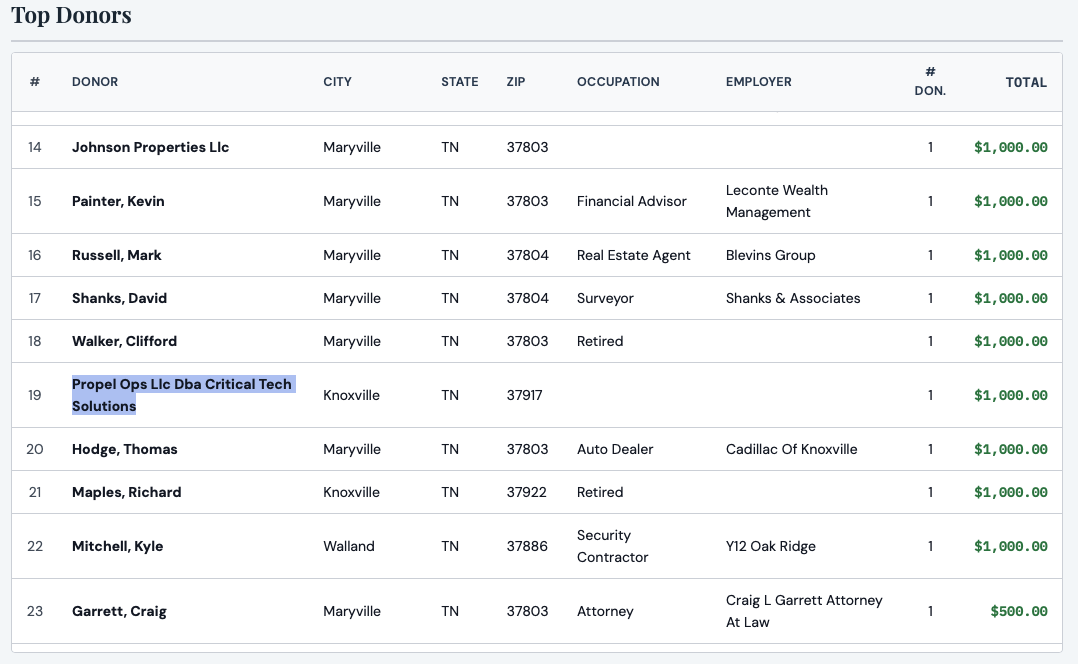
Figure 1. OpenTN campaign finance records showing Propel Ops LLC dba Critical Tech Solutions among the reported campaign contributors.
Preview: Critical Tech Solutions Website
If the preview does not display on your device,
click here to open the PDF.
The documented facts, summarized: a private surveillance-equipment vendor that markets a no-competitive-bid purchasing path to government agencies, that already has the Maryville Police Department as a customer, that publicly uses the police chief’s name and department in its sales marketing, and that quotes the department’s lieutenant in a customer case study, has also contributed financially to that same police chief’s campaign for state legislative office.
This is the second documented vendor relationship surfaced by records on this page. The first is the Flock Safety relationship described in Section 2. The pattern visible across both vendors (direct vendor-to-chief communication, marketing use of MPD identifiers, no-competitive-bid procurement paths, and a documented campaign contribution from at least one of them) is one voters in District 8 are entitled to consider when evaluating who is funding this campaign and why.
Police-Chief Donors From Other Tennessee Jurisdictions
Five sitting police chiefs from outside Blount County have contributed to the campaign:
- Timothy Coleman, Chief, Berry Hill Police Department (Goodlettsville): $500
- Mark Gibson, Chief, Cleveland Police Department: $110
- Terry Cannon, Chief, Greeneville Police Department: $101
- Richard Catlett, Chief, Pigeon Forge Police Department: $101
- Jerone Holt, Chief, Burns Police Department (Dickson): $101
The elected representative for Tennessee House District 8 will vote on state legislation governing police practices, including the authority and constraints on surveillance technology that is the subject of this page.
The Public-Integrity Question
Public corruption is not always an envelope of cash. Sometimes the public concern is a closed system of access, favors, vendor relationships, political endorsements, family donations, no-competitive-bid purchasing pathways, appointments, and government influence that reinforces itself while ordinary residents are locked out of the decision-making process.
That is the public-integrity question raised by the record on this page: a sitting police chief tied to Maryville’s Flock Safety surveillance rollout; direct vendor-to-chief communications; vendor hospitality questions; HUD grant facilitation for a private surveillance vendor; a proposed $300,000 to $600,000 drone program; a separate surveillance-equipment vendor using Maryville PD and Chief Crisp in its marketing; that same vendor contributing to the chief’s campaign; a maximum-dollar donation from a donor publicly connected to the current District 8 political household; and police chiefs from other Tennessee jurisdictions contributing to the campaign.
MaryvillePrivacy.org does not allege criminal corruption. It documents the public record so voters can decide whether this reflects open government accountable to ordinary District 8 residents, or insider government shaped by political, law-enforcement, vendor, donor, and institutional relationships.
Sources: OpenTN.org candidate page for Tony Jay Crisp, parsed from Tennessee Bureau of Ethics and Campaign Finance public disclosure filings; Critical Tech Solutions corporate website at criticaltechsolutions.com (homepage testimonials, customer case studies, procurement page); Jerome Moon official campaign biography at jeromemoonformayor.com. Filings reflect the Q1 2026 reporting period; additional disclosures will be filed before the August 6, 2026 primary.
📬 Questions for Candidate Tony Jay Crisp
As a candidate for the Tennessee House of Representatives, Chief Crisp’s record as the operating head of a municipal mass-surveillance program is squarely relevant to his fitness for state legislative office, where he would be in a position to vote on bills governing exactly these practices. The following questions arise directly from records on the public file. He is invited to answer them publicly, in writing, before the August 6, 2026 Republican primary.
- Vendor hospitality. The March 27, 2025 vendor email opens with “Thank you for the hospitality last week. It was a blast!” What did that hospitality consist of? Who provided it? Who paid for it? Was it on or off duty time? Will you commit, as a candidate, to publishing a complete log of vendor meals, gifts, travel, and event attendance you and your command staff have received from Flock Safety since 2023?
- Vendor events. Were the Flock Forward conference at Loews Atlanta (June 12–14, 2024) and the East TN Regional Flock Safety Deep Dive Training in Sevierville (March 1, 2024) attended by you or any Maryville PD staff? On duty time? At what cost to the city, if any? What written department policy governed the decision to attend?
- HUD grant facilitation. Why did you agree to introduce a private vendor’s sales representative to the executive director of the Maryville Housing Authority for the explicit purpose of helping that vendor secure a federal grant-funded purchase order? Do you consider acting as a sales facilitator for a private vendor, while serving as Chief of Police, consistent with the duties of a department head?
- RFP process. Was any competitive bid process, RFP, or public solicitation conducted before the proposed $300,000 to $600,000 drone-as-first-responder program was negotiated directly with Flock Safety’s sales representative? If not, why not, and on what authority?
- Written vendor policies. The Maryville Police Department has confirmed it has no written department policy governing vendor meals, hospitality, gifts, or travel. Why not? Will you commit, as a candidate, to publishing a written department policy on these matters before the August 6, 2026 primary?
- Written ALPR policies. The Department has confirmed in writing that it has no written policies governing who can search the Flock ALPR system, what justification is required, what supervision is in place, or under what authority a vehicle may be added to a hidden Safe List. As Chief of the agency operating this system, why not?
- Supervisor approval. Documented misuse cases nationwide, including Oak Ridge officer Zachary Gauthier’s guilty plea to 18 counts of Flock misuse, less than 20 miles from Maryville, were discovered after the fact, not prevented in advance, because no supervisor-approval workflow was in place. Why has Maryville not implemented a supervisor-approval requirement for ALPR searches? Will you commit to implementing one before the primary?
- Carpenter v. United States. The Supreme Court held in Carpenter that warrantless government acquisition of historical location data implicates the Fourth Amendment. Mass ALPR systems collect the same category of data on every driver, without warrant or suspicion. Do you believe the Fourth Amendment as you understand it permits this kind of mass collection? If elected to the Tennessee House, would you support a state statute requiring a warrant for retroactive ALPR searches?
- Cross-agency data sharing. Maryville’s Flock Safety transparency portal confirms data is shared with hundreds of agencies nationwide, while a Maryville PD memo claims “no formal agreement.” Which is accurate? If elected to the Tennessee House, would you support a state statute capping ALPR data retention, restricting cross-state sharing, and requiring annual public audits?
- AI capabilities beyond plates. Flock Safety’s U.S. Patent No. 11,416,545 describes capabilities for identifying people by race, gender, clothing, height, and weight, in addition to license plate recognition. Were Maryville residents, or the City Council, informed of these AI capabilities prior to the July 2, 2024 vote authorizing the system? If elected to the Tennessee House, would you support a state statute requiring public disclosure of AI-enabled person-identification capabilities by any system operating in Tennessee?
- Public infrastructure for private surveillance. Flock Safety’s cameras are mounted on publicly-funded utility infrastructure, capture data from public space, and the resulting database is sold back to the City as a paid subscription. Do you regard this public-infrastructure, private-database, government-subscription business model as consistent with the Fourth Amendment in spirit? Why or why not?
- Critical Tech Solutions vendor relationship and marketing use of your name. The Knoxville-based surveillance-equipment vendor Critical Tech Solutions (Propel Ops LLC) publicly displays your name and the Maryville Police Department identifier on its homepage as a sales testimonial, publishes a customer case study quoting Lt. Fernandez, and has contributed $1,000 to your campaign. Did the City of Maryville authorize the use of your name and the Department’s name in this vendor’s marketing materials? Did any Maryville Police Department personnel review or approve the testimonial language attributed to the Department? Under what written policy?
- Maryville PD purchases from Critical Tech Solutions. Has the Maryville Police Department purchased any equipment from Critical Tech Solutions / Propel Ops LLC since 2023? If so, through what procurement process: a competitive bid, a public RFP, or the TIPS cooperative no-competitive-bid path the vendor markets on its procurement page? Will you commit to publishing a complete record of MPD’s purchases from this vendor, including dates, dollar amounts, and the procurement documentation, before the August 6, 2026 primary?
- Campaign contributions and state legislative recusal. As a candidate for the Tennessee House, will you commit to recusing from any state legislative vote affecting surveillance-equipment procurement, cooperative no-competitive-bid government purchasing pathways, or surveillance vendor contracting, if any of the affected vendors have contributed to your campaign? If you would not commit to recusal, what other safeguard do you intend to apply?
- Which job absorbs the loss. You have stated that if elected you intend to remain Maryville’s Public Safety Director. The 2026 General Assembly convened January 13 and adjourned April 24, roughly fifteen weeks in Nashville, about 200 miles from Maryville. During those weeks, which duties of the Public Safety Director position will not be performed by you, and who will perform them instead?
- Compensation. Will you continue to draw the full Public Safety Director salary from Maryville taxpayers while also drawing the state legislative salary of $33,060 per year plus per diem at the greater-than-50-miles rate from Tennessee taxpayers? If yes, will you commit to publishing both compensation figures, in full, before the August 6, 2026 primary?
- Emergency command authority. As Director of Public Safety you hold command responsibility for both the Police Department and the Fire Department. If a mass-casualty incident, major fire, or critical incident occurs in Maryville while you are in a committee hearing or floor session in Nashville, who holds command authority, under what written delegation, and has that delegation been reduced to a signed City policy document available to the public?
- Written approval from the City. Has the City Manager, the City Council, or the City Attorney reviewed and approved in writing your stated plan to hold state legislative office concurrently with the Public Safety Director position? Will you release that written approval, or confirm that no such written approval exists?
- Voting on the department you command. As a state legislator you would vote on statutes governing municipal law enforcement, including ALPR retention, warrant requirements, records access, and surveillance procurement, while simultaneously commanding a municipal agency operating a 16-camera ALPR network with no written search policy. Will you recuse yourself from votes affecting the operations of the department you personally command? If not, what safeguard do you propose in place of recusal?
Responses received from the candidate, in writing, will be published on this page in full and unedited. The candidate’s official campaign contact channel is tonycrispforstatehouse8.com; his municipal contact information is on the homepage Contact City Officials section.
Why This Is a Constitutional Question, Not a Partisan One
A resident who supports law enforcement and a resident who is wary of expanded surveillance can and should agree on one structural point: when a private company collects mass location data on every citizen in public space, hosts it in an out-of-state database, and sells access back to the local government as a subscription, the result is a system that produces, in practical effect, the kind of warrantless surveillance the Fourth Amendment was written to forbid. The legal categorization of the data as “private” because a private company collected it does not change the practical reality of what the data is, what it permits, and whom it tracks.
This is not a partisan position. Riley v. California was decided unanimously. Carpenter v. United States was authored by a Chief Justice who joined the Court’s conservative wing. The Institute for Justice, a libertarian public-interest law firm, is currently litigating exactly this issue in federal court. The Electronic Frontier Foundation, a civil-liberties organization, has documented the same business-model concerns. The American Civil Liberties Union has obtained federal records confirming the warrantless-purchase pattern at the federal level.
A candidate for the Tennessee General Assembly who has spent the last several years operating one of these systems, expanding it through a single-vendor relationship, accepting and providing hospitality with the vendor’s sales representative, and refusing to publish written policies governing its use, is asking voters for the authority to write the laws that will govern this technology across the State of Tennessee. The voters of District 8 are entitled to ask whether his record on these specific issues makes him the right person to do that.
The Inheritance Question
Mass automated surveillance, once installed, is rarely removed. The cameras on Maryville’s utility poles, the out-of-state vendor database holding the travel histories of every driver who has passed through the city since 2024, and the data-sharing relationships with hundreds of police agencies are infrastructure that will outlast the elections of the people who installed it. The next generation of Maryville residents, and the next generation of Tennesseans, will inherit the community these decisions are creating right now.
Whether the community they inherit comes with the constitutional protections that have governed American privacy for over two centuries (warrant requirements, judicial oversight, written policies, statutory retention limits, and meaningful audit reporting), or whether it comes with none of those things, depends on the people Tennessee voters elect to the General Assembly to write the laws governing this technology. That is the constitutional question on the ballot in District 8 on August 6, 2026.
Primary-Source Documents and Authoritative References
- Tennessee Secretary of State petition list: Petitions Filed for Tennessee House of Representatives, March 12, 2026 (PDF). District 8 entry: Tony Jay Crisp, Republican, Maryville.
- Official campaign website: tonycrispforstatehouse8.com
- Campaign Facebook page: Tony Jay Crisp for TN State Representative District 8
- Tennessee General Assembly District 8 page: wapp.capitol.tn.gov
- City of Maryville Police Administration page listing Tony J. Crisp as Chief of Police / Director of Public Safety: maryvillegov.com/police-administration.
- City of Maryville Fire Department page listing Tony J. Crisp as Fire Chief / Director of Public Safety: maryvillegov.com/fire-department-home-page.
- Tennessee General Assembly session calendar and member compensation: Ballotpedia. Base salary $33,060 per year plus per diem; 2026 session convened January 13 and adjourned April 24.
- Tennessee Code Annotated, Title 3, Chapter 1 governing General Assembly salaries, per diem, and the ninety legislative day limit per two-year term.
- Drone program emails: “Re: Flock Drones,” Alex Guth to Tony Crisp, March 27 – April 1, 2025 (full thread PDF).
- Drone coverage map and pricing: PDF.
- HUD grant facilitation: Email thread “Re: Flock Grant – Maryville HUD,” Alex Guth and Tony Crisp, Feb. 17 – March 3, 2025 (TPRA records).
- Flock Forward Atlanta invitation: Alex Guth to Tony Crisp and Tennessee chiefs/command staff, Feb. 27, 2024 (TPRA records).
- East TN Regional Sevierville training: Calendar invitation to tjcrisp@maryville-tn.gov, March 1, 2024 (TPRA records).
- March 20, 2024 vendor meeting: Email exchange between Lt. Rod Fernandez and Chief Crisp, March 15, 2024 (TPRA records).
- Flock Lunch – Small Town: Calendar acceptance and reply from Chief Crisp confirming Deputy Chief Cooke would attend (TPRA records).
- Subscription quotes: Flock Group Inc. budgetary quotes Q-112275 (Falcon Flex, $3,500/yr) and Q-112307 (Falcon, $3,000/yr + $650 implementation), dated Nov. 11, 2024 (TPRA records).
- Flock Safety Transparency Portal, Maryville TN PD: transparency.flocksafety.com/maryville-tn-pd.
- Flock Safety operational analytics dashboard for Maryville PD: period October 18 to November 12, 2024 (26 days). Approximately 3.3 million capture events, 2,952,335 Tennessee-plate captures. Released by City of Maryville under TPRA in 2024. View dashboard image.
- Maryville Police Administration page: maryvillegov.com.
- Riley v. California, 573 U.S. 373 (2014) and Carpenter v. United States, 585 U.S. ___ (2018).
- Institute for Justice Plate Privacy Project: plateprivacy.com and the Schmidt v. City of Norfolk federal lawsuit.
- Electronic Frontier Foundation: Automated License Plate Readers issue page; Bennett Cyphers et al., “Inside Fog Data Science, the Secretive Company Selling Mass Surveillance to Local Police,” 2022.
- American Civil Liberties Union: Privacy and Technology issue page; FOIA documents on DHS warrantless purchase of cellphone location data, July 2022.
Page topics include: Maryville Flock Safety cameras, ALPR surveillance, license plate reader privacy, the Fourth Amendment workaround, public-infrastructure-funded private surveillance, police surveillance vendor relationships, vendor hospitality, no-bid and no-competitive-bid procurement, drone-as-first-responder procurement, HUD grant facilitation, campaign finance disclosures, campaign donations from a surveillance-technology vendor, public integrity questions, ethics concerns, procurement oversight, government accountability, separation of roles between regulator and regulated, legislative recusal, and the documented vendor relationship between Chief Crisp and Flock Safety sales representative Alex Guth.
This page also addresses public questions that voters may search for regarding Tony Jay Crisp, Maryville Police Department, Maryville Fire Department, Flock Safety, Critical Tech Solutions / Propel Ops LLC, campaign contributions, corruption concerns, ethics complaints, public-integrity review, state oversight, and whether any agency has made a finding of misconduct. MaryvillePrivacy.org does not allege criminal corruption or state that any agency has made a finding of misconduct. The page documents public records, campaign-finance disclosures, vendor marketing materials, published government salary and session data, and Tennessee Public Records Act productions so voters can evaluate the record for themselves.