⚠
Maryville’s reported Sept. 18 Flock discussion has
not yet been confirmed by an official city agenda.
Regional details▾
├── Knox County
Knox County Commission voted Aug. 31 to ban fixed
automatic license plate reader cameras following
weeks of public opposition and scrutiny of the
Sheriff’s Office surveillance program.
We are reviewing the final adopted ordinance and
implementation details.
├── Kingston
Kingston’s Flock contract will not be renewed.
├── Sullivan County
Sullivan County suspended its use of Flock cameras.
├── Loudon County
A proposed Flock deployment stalled following public opposition.
├── Anderson County
Anderson County will hold a public meeting Sept. 10
at 6 p.m. at Clinton High School to hear public input
regarding Flock cameras.
Citizens will have up to three minutes for public comment.
├── Oak Ridge
Oak Ridge City Council meets Sept. 14 at 7 p.m.
Local opponents of Flock are organizing for public comment.
└── Maryville
A Sept. 18 Maryville City Council work-session discussion
regarding Flock cameras has been publicly reported, but
an official city agenda has not yet been posted.
This page will be updated when official city notice is published.
A practical toolkit for pushing back on automated license plate readers and
mass surveillance: remove cameras, map the network, audit its use,
reduce unnecessary data collection, and cut other vehicle-data feeds.
UpdatedSeptember 2026
FocusAction & Countermeasures
ScopeMaryville & Tennessee
Counter-Flock Snapshot
Best Result
REMOVE
Take the Camera Down
Contract, records, public pressure, non-renewal
Know the Network
MAP IT
See the Cameras
Maryville map + DeFlock route awareness
Audit the Watchers
CHECK
Have I Been Flocked?
Request searches, alerts, and audit records involving your plate
Know First
LEGAL
Counter Surveillance
Don’t obscure the plate or interfere with equipment
Take it down.
Flock works by accumulating vehicle observations.
The strongest countermeasure is removing the surveillance infrastructure.
Until that happens, use the tools you control to create fewer unnecessary
observations, fewer unnecessary identifiers, and fewer outside data feeds.
Counter-Flock Strategy
COUNTER FLOCK
│
├── 1. REMOVE THE SYSTEM
│   └── contract · records · public action · removal
│
├── 2. AVOID THE SYSTEM
│   └── map fixed cameras · make informed route choices
│
├── 3. DENY USEFUL DATA
│   └── reduce unnecessary reads and identifiers
│
├── 4. CUT OTHER DATA FEEDS
│   └── connected car · cloud cameras · apps · telematics
│
└── 5. KNOW THE LEGAL LINE
    └── keep the plate lawful · don't interfere with equipment
The most effective countermeasure is not a gadget or vehicle trick.
It is ending the surveillance program. That starts by finding the contract,
documenting how the system is actually used, and putting a specific decision
in front of the people who authorized it.
COUNTER-SURVEILLANCE PRINCIPLE
Attack the program at its decision points.
Contracts expire. Budgets require approval. Policies can be changed.
Expansion can be stopped. The camera exists because a government entity
continues choosing to operate it.
The Removal Playbook
FIND THE CONTRACT
│
├── renewal date
├── expiration date
├── camera count
├── cost
├── funding source
└── proposed expansion
    │
    ▼
GET THE RECORDS
│
├── audit logs
├── search activity
├── sharing
├── retention
├── policies
├── training
└── vendor correspondence
    │
    ▼
MAP THE NETWORK
    │
    ▼
SHOW THE PUBLIC
    │
    ▼
PUT IT BEFORE DECISION-MAKERS
    │
    ▼
ASK FOR A SPECIFIC RESULT
│
├── no expansion
├── moratorium
├── non-renewal
├── public vote
└── removal
1. Find the Contract
Start with the documents that tell you when the next real decision happens:
the current contract, amendments, invoices, purchase orders, grants, camera
count, funding source, renewal date, and expiration date.
LOCAL PRIMARY SOURCE · MARYVILLE
PHYSICAL INFRASTRUCTURE
The Camera Is the Visible Part
The pole and camera are easy to see. The contract, access rules,
retention settings, sharing relationships, and renewal decisions
behind it require records.
CONTRACT DOCUMENT
Maryville Police · Flock Law Enforcement Agreement
Read the underlying agreement instead of relying on a vendor sales
description. Contract documents are where residents can identify
terms, responsibilities, costs, renewal provisions, and other
obligations governing the system.
01 · WHEN
Expiration, renewal, amendment, or next approval.
02 · HOW MUCH
Subscription cost, equipment, grants, and funding source.
03 · WHO APPROVES
Police, administration, purchasing, mayor, or council.
04 · EXIT POINT
Non-renewal, termination, budget denial, or policy change.
2. Build the Record
Request records showing how the system actually operates: searches,
audit logs, hotlist activity, sharing settings, retention, user access,
policies, training, and correspondence with Flock.
The basic rule:
The sales pitch tells you what the system is supposed to do.
The records tell you how your agency actually uses it.
3. Map the Network
Document where the cameras are located and which direction they face from
places where you are lawfully present. A surveillance system is easier to
debate when residents can actually see its footprint.
4. Put It on the Public Record
Email elected officials. Attend work sessions. Speak during public comment.
Share primary-source records with neighbors and reporters. Ask officials to
explain the program in public rather than allowing surveillance policy to
exist only inside vendor contracts and police software.
5. Ask for a Decision
Do not stop at “I have privacy concerns.” Ask for an outcome:
do not expand it, do not renew it, pause it pending a public review,
require a public vote, or remove it.
Maryville residents:
Maryville’s current City Council consists of Mayor Andy White,
Vice-Mayor Fred Metz, Tommy Hunt, Sarah Herron, and Drew Miles.
Regular meetings are held on the first Tuesday of each month at 7 p.m.
Build the paper trail:
Tennessee public records can be used to obtain existing contracts,
policies, audit records, invoices, correspondence, and other government
records concerning the program.
Rep. Tim Burchett introduced H.R. 9800 on July 21, 2026.
The bill would restrict federal use, access, and funding of specified
automated mass-surveillance systems. It remains pending in Congress.
If your local police department uses Flock, ask for existing records showing
whether your plate appears in Flock search, alert, hotlist, or audit activity.
In Tennessee, this is a Tennessee Public Records Act request,
not a federal FOIA request.
The Camera Is Only Half the System
The camera collects the observation. Audit records can help show
who later searched, queried, or acted on the data.
COUNTER-SURVEILLANCE PRINCIPLE
Do not just ask what the cameras collected. Audit who used the system.
Search logs, user IDs, timestamps, reasons, hotlist activity, and related case
numbers can reveal how the surveillance network was actually used.
Important distinction:
“Was my vehicle ever photographed by a Flock camera?” and
“Was my plate searched, alerted on, or queried by a user?” are not necessarily
the same records question.
Historical camera detections may disappear when the agency’s retention period
expires. Search and audit records may be maintained separately.
EXTERNAL AUDIT-LOG SEARCH
Search HaveIBeenFlocked.com
Check whether your license plate appears in Flock audit logs obtained
through public-records requests. A match means an operator searched that
plate in records included in the site’s dataset; it does not mean the site
has a record of every time your vehicle passed a camera.
Privacy:
HaveIBeenFlocked.com says it does not save, store, or log the plate numbers
or search terms entered into its lookup.
Build the Audit Trail
YOUR LICENSE PLATE
│
├── SEARCH / QUERY
│   ├── date + time
│   ├── user / agency
│   └── stated reason
│
├── ALERT / HOTLIST
│   ├── alert type
│   ├── recipient
│   └── disposition
│
├── AUDIT LOG
│   ├── operator ID
│   ├── agency
│   └── event
│
└── RELATED RECORD
    ├── case number
    ├── incident number
    └── report number
        if maintained
IDENTIFY THE USER
MPD Name ↔ ID Crosswalk
If a Maryville Flock audit record identifies an operator by an ID,
use the crosswalk below to compare that identifier with documented
Maryville Police names and IDs.
🧩 Name ↔ ID mapping (derived)
Search by name or ID. Click column headers to sort on desktop.
Keep the request targeted.
A plate number plus a defined date range and specific audit fields gives the
records custodian a much narrower search than asking for every Flock record
the agency possesses.
AUDIT WORKFLOW
01 SEARCH YOUR PLATE
│
▼
02 REQUEST AGENCY AUDIT RECORDS
│
▼
03 IDENTIFY USER / OPERATOR ID
│
▼
04 CROSSWALK ID TO MPD NAME
│
▼
05 CHECK SEARCH REASON + CASE NUMBER
│
▼
06 PRESERVE THE RECORD
Section 3 · Know the Network
Know the Fixed Camera Network
Fixed ALPR cameras work because vehicles repeatedly pass known collection
points. Once those locations are mapped, the network becomes easier to
understand, document, and account for when choosing an ordinary route.
COUNTER-SURVEILLANCE PRINCIPLE
First identify the collection points.
A camera network is easier to account for when you know where the fixed
sensors are, what direction they face, and which roads they cover.
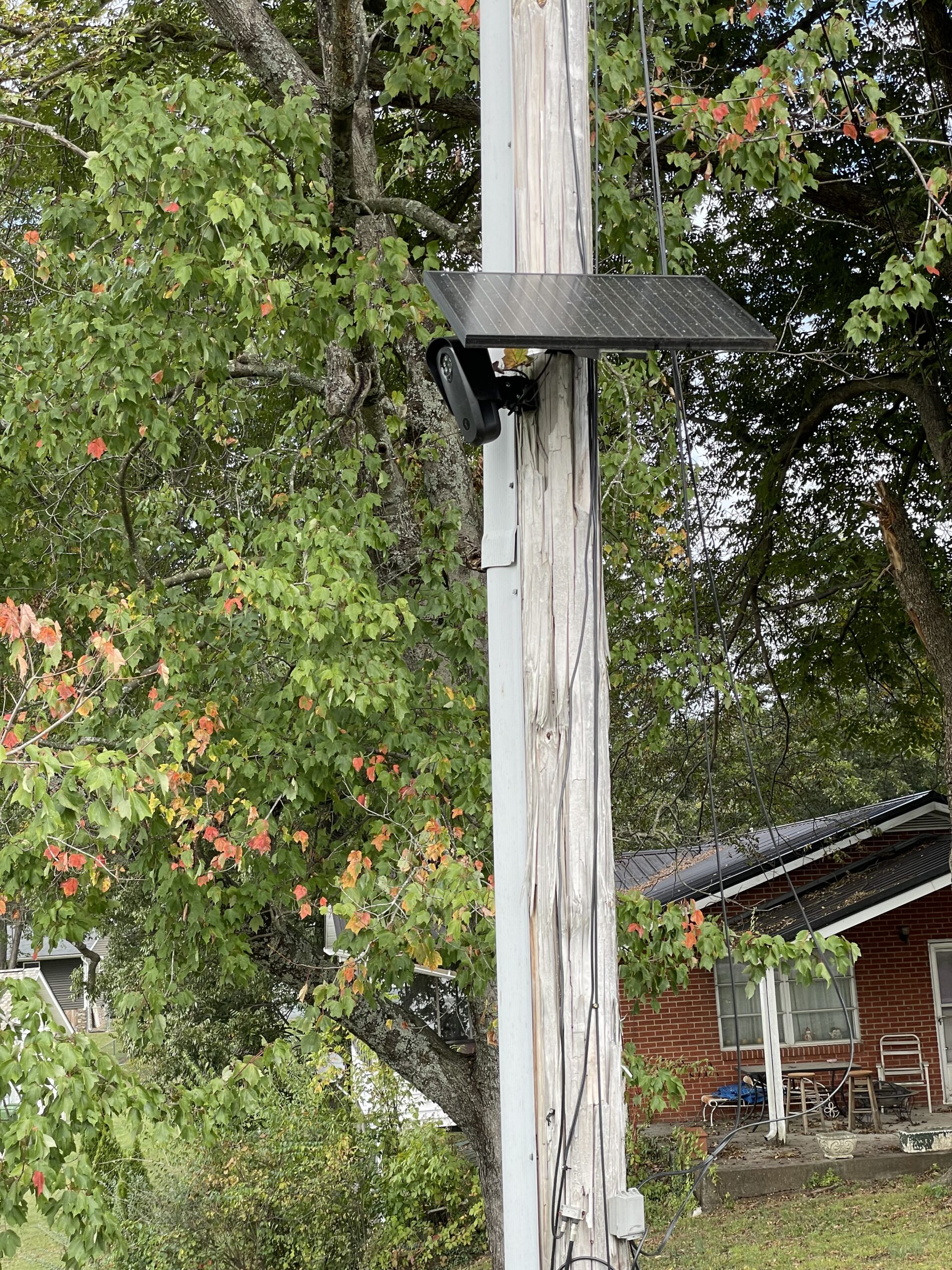
Recognize the Collection Point
Example of a documented Flock camera in Maryville near
US 129 and Foch Street. Knowing what the hardware looks like makes
it easier to document fixed locations accurately.
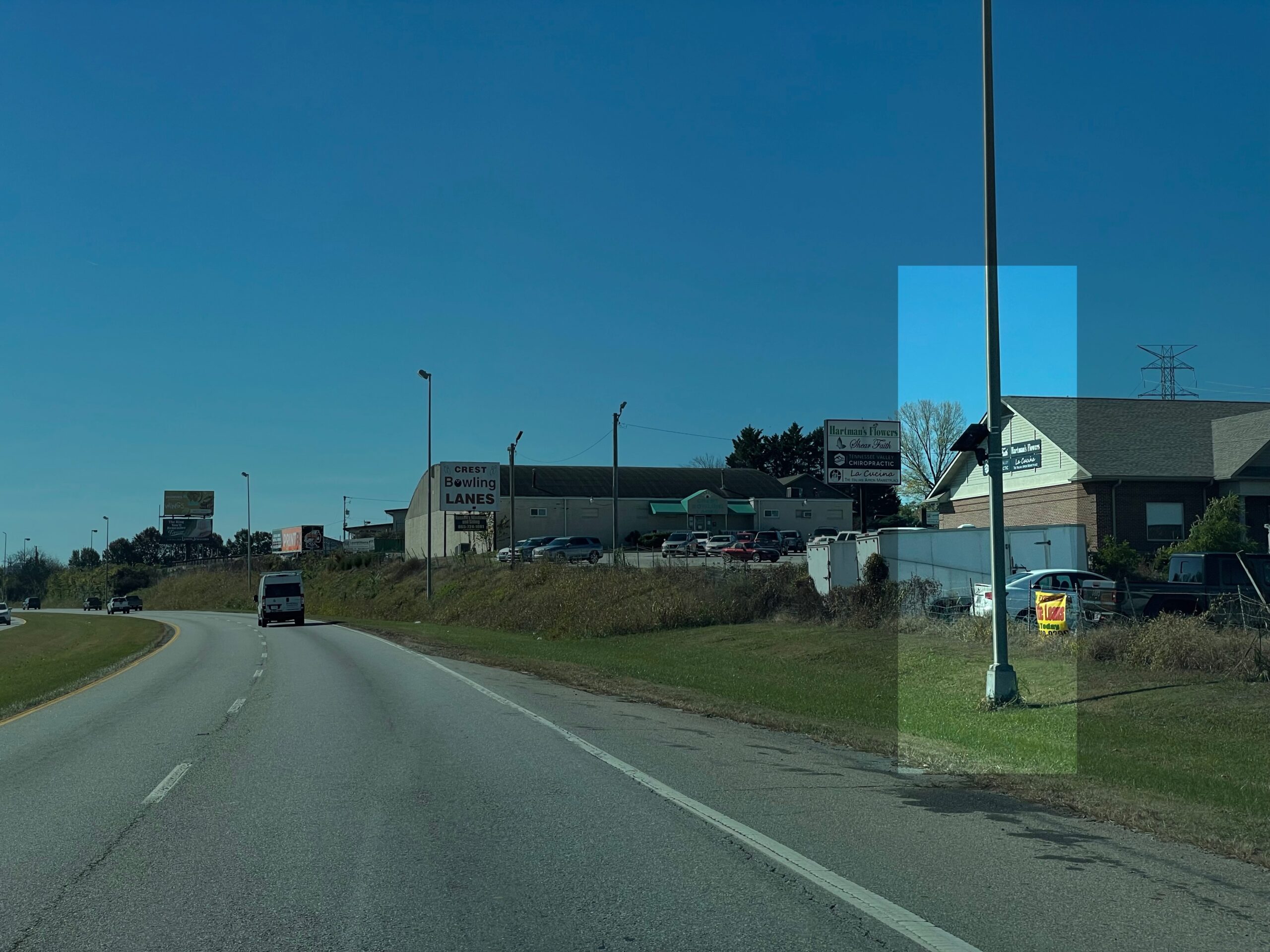
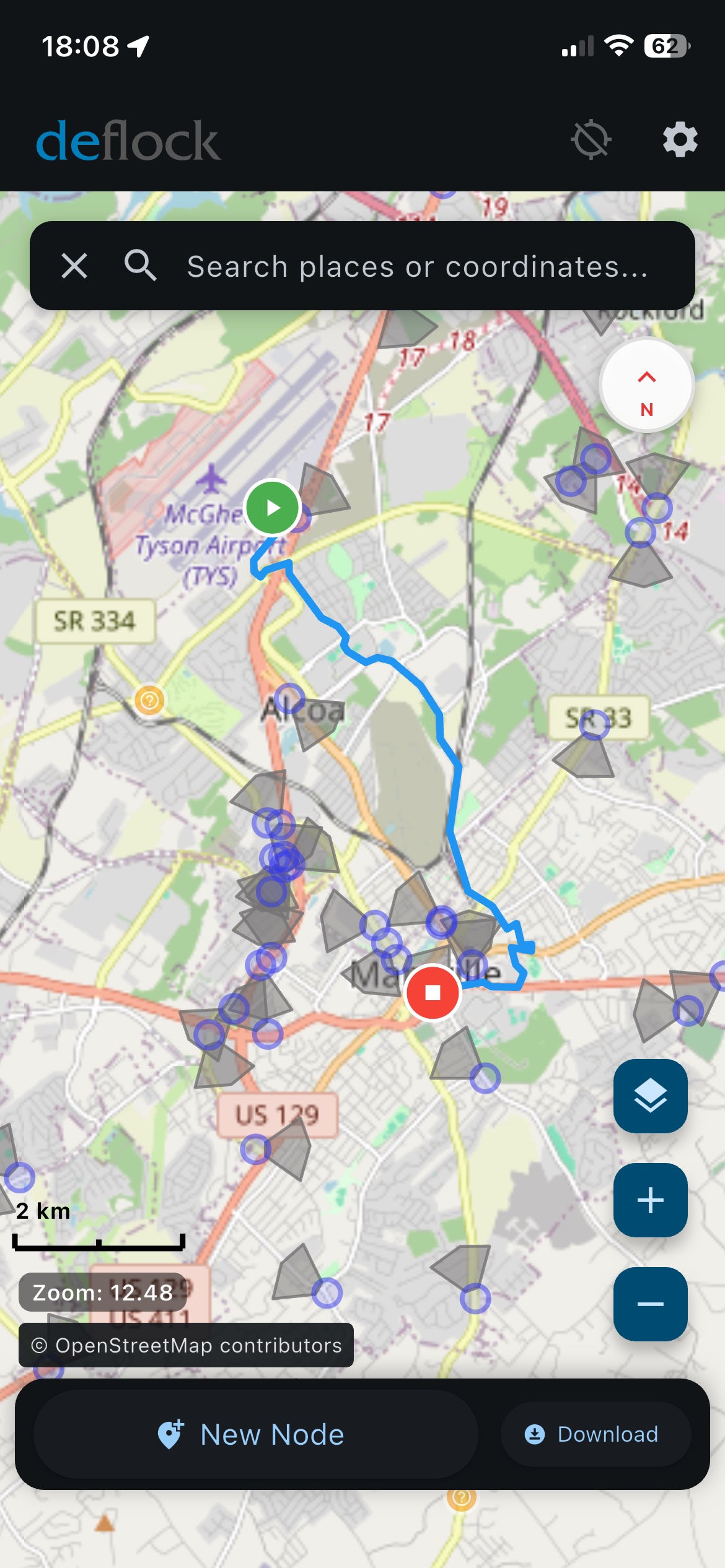
ROUTE AWARENESS
Map Before You Drive
DeFlock can display documented ALPR locations alongside a driving route,
letting you compare ordinary roads before deciding which route makes sense.
FIXED-CAMERA AWARENESS CHECK
01 · LOCATION
Know the road, intersection, or access point.
02 · DIRECTION
Note which travel lane or direction the camera observes.
03 · ROUTE
Compare other ordinary roads before leaving.
04 · VERIFY
Treat community maps as intelligence, not a guarantee of complete coverage.
MAPPING TOOLS
Maryville Camera Map
Documented Flock and ALPR camera locations around Maryville and Alcoa.
Use the map before the trip.
You do not have to choose the route that creates the most surveillance
observations. If another ordinary road makes sense, knowing the fixed
camera locations gives you the information to make that choice.
Improve the map.
From a place where you are lawfully present, document the camera location,
road, and direction of observation and contribute accurate information to
local or community maps.
Section 4 · Deny Useful Data
Reduce the Information the System Can Accumulate
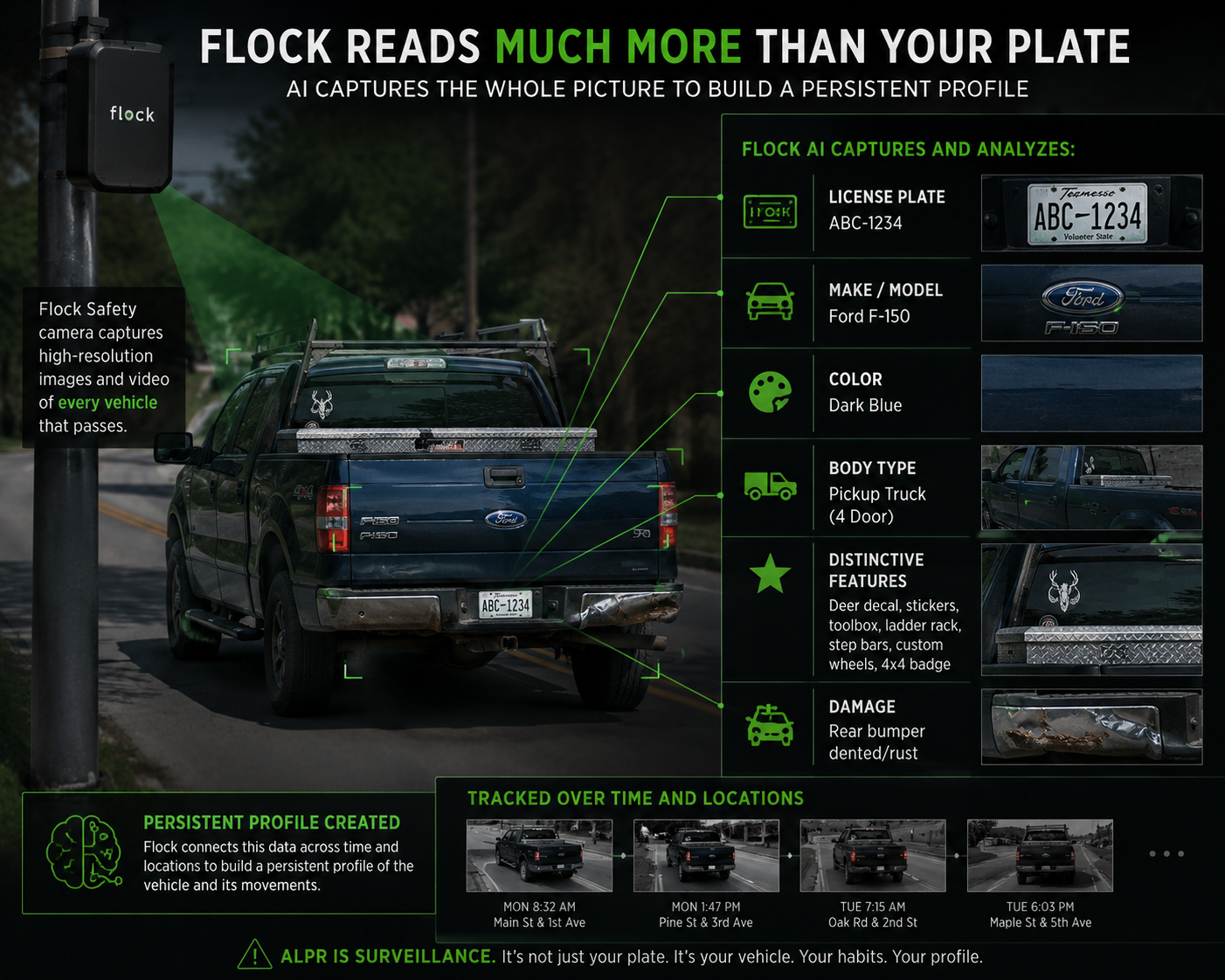
Flock’s own materials describe license plate recognition records containing
the plate, vehicle characteristics, date, time, and camera location.
Flock also advertises Vehicle Signature searches using make, color, body type,
and other visible vehicle characteristics.
One observation is one data point. Repeated observations across locations
and time can create a much more useful movement history.
DATA-MINIMIZATION PRINCIPLE
The goal is not invisibility.
The goal is to stop volunteering unnecessary information that makes
automated vehicle observations more distinctive, consistent, and useful.
What Makes an Observation Useful
VEHICLE OBSERVATION
│
├── plate / plate characters
├── vehicle image
├── make / color / body type
├── distinguishing characteristics
├── camera location
└── date + time
    │
    ▼
ONE SEARCHABLE OBSERVATION
    │
    │ repeated
    ▼
MORE COMPLETE MOVEMENT HISTORY
VEHICLE SIGNATURE
The Plate Is Only One Identifier
Vehicle appearance, equipment, decals, body type, color, and other visible
characteristics can add context to an ALPR observation.
Reduce Unnecessary Camera Reads
01 · KNOW THE CAMERAS
When another ordinary route works for you, a known fixed camera does not
have to be part of every trip.
02 · REDUCE OPTIONAL TRIPS
Walk, bike, combine errands, or ride with someone else when those choices
already make sense.
03 · USE PRIVATE PARKING
A garage or other private parking area can reduce unnecessary roadside
exposure when that option already exists.
04 · AVOID PERFECT REPETITION
Combine optional trips and use different legitimate routes when convenient
instead of automatically generating the same observation pattern.
Reduce Unnecessary Vehicle Identifiers
VEHICLE DATA-MINIMIZATION FIELD GUIDE
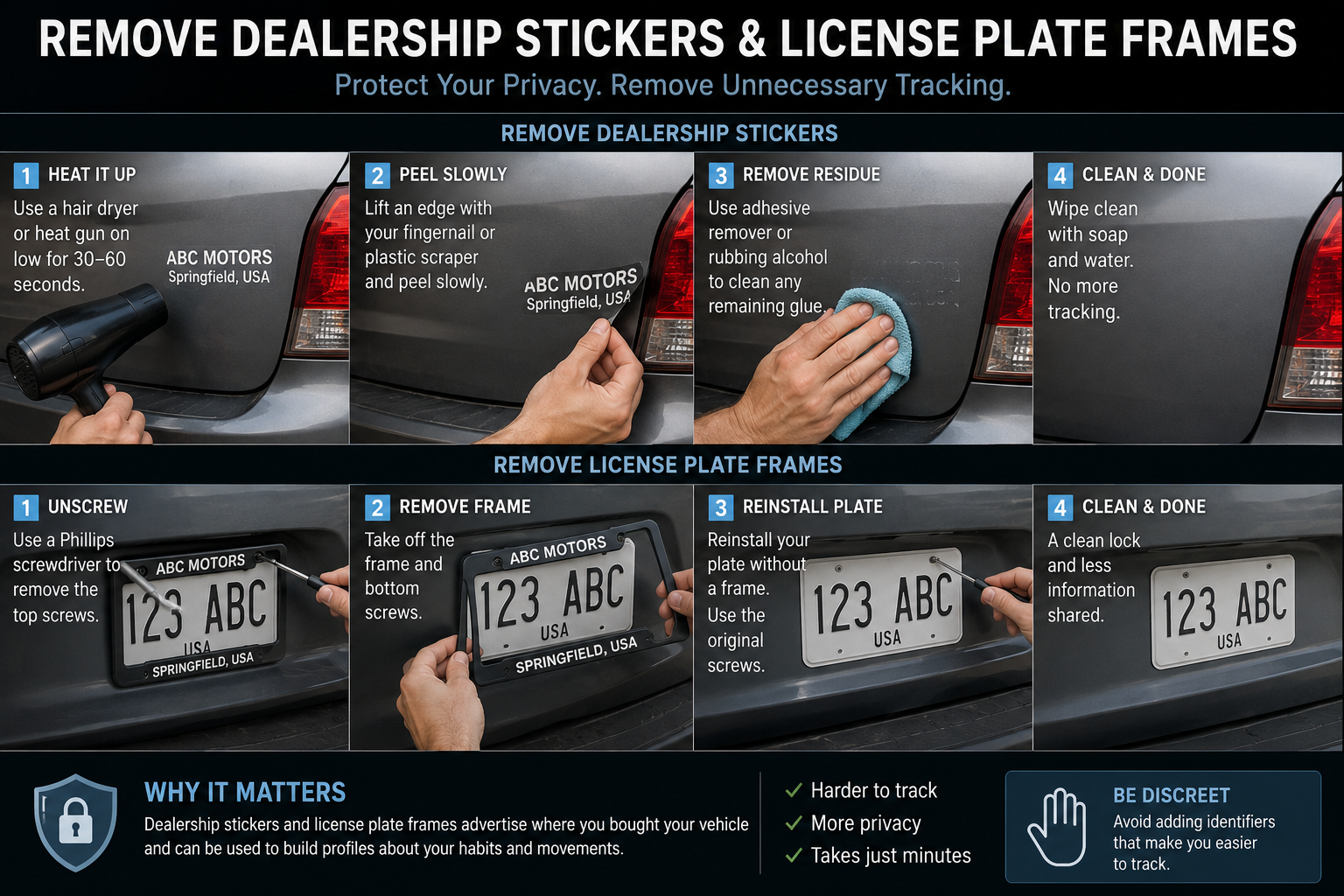
REMOVE UNNECESSARY MARKINGS
Dealer Advertising
Dealer stickers and branded frames add permanent visual information to
your vehicle while providing you little benefit.
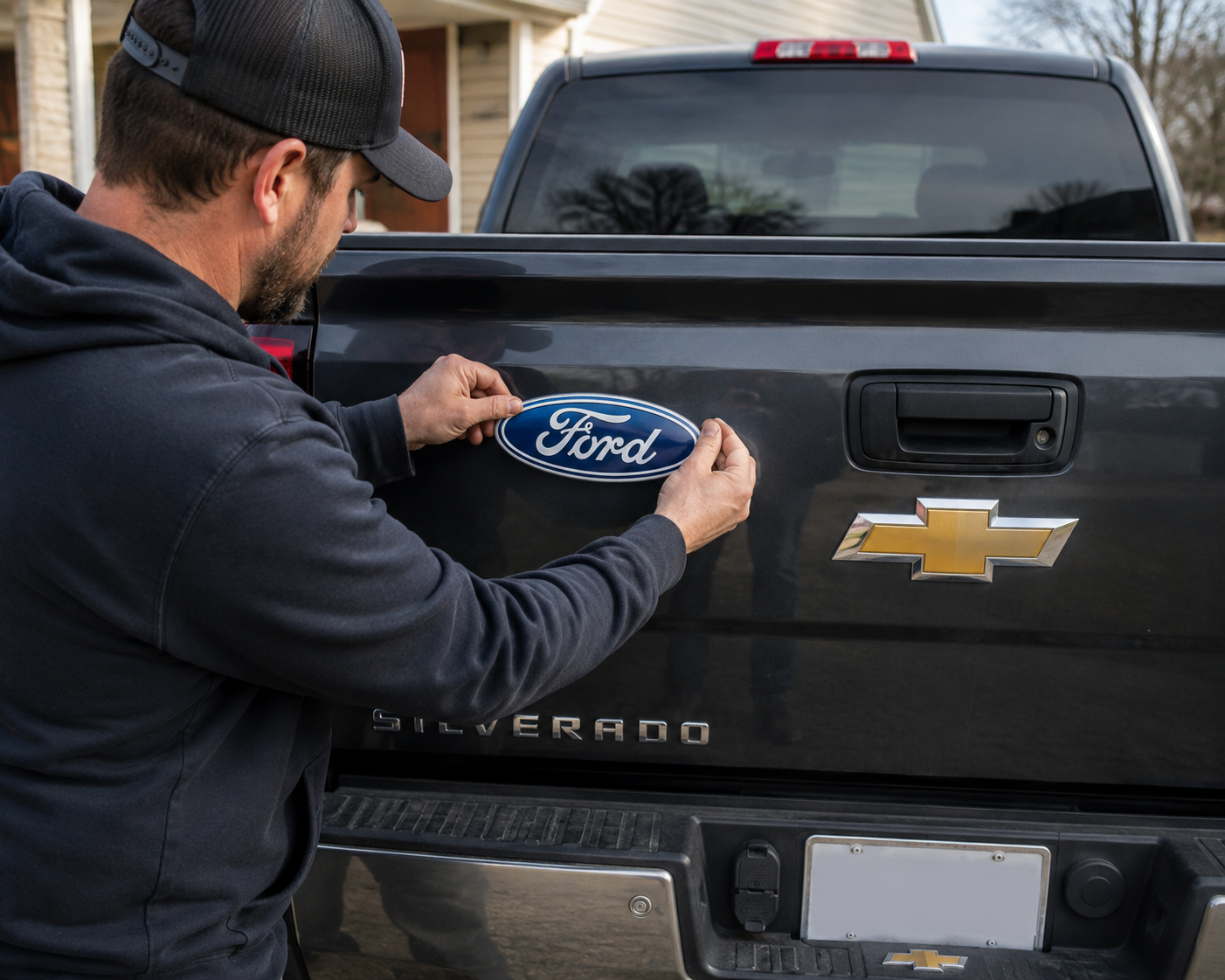
REDUCE DISTINCTIVE MARKERS
Decals, Magnets & Stickers
Distinctive markings can help differentiate one otherwise common vehicle
from another. Keep the ones you actually want or need.
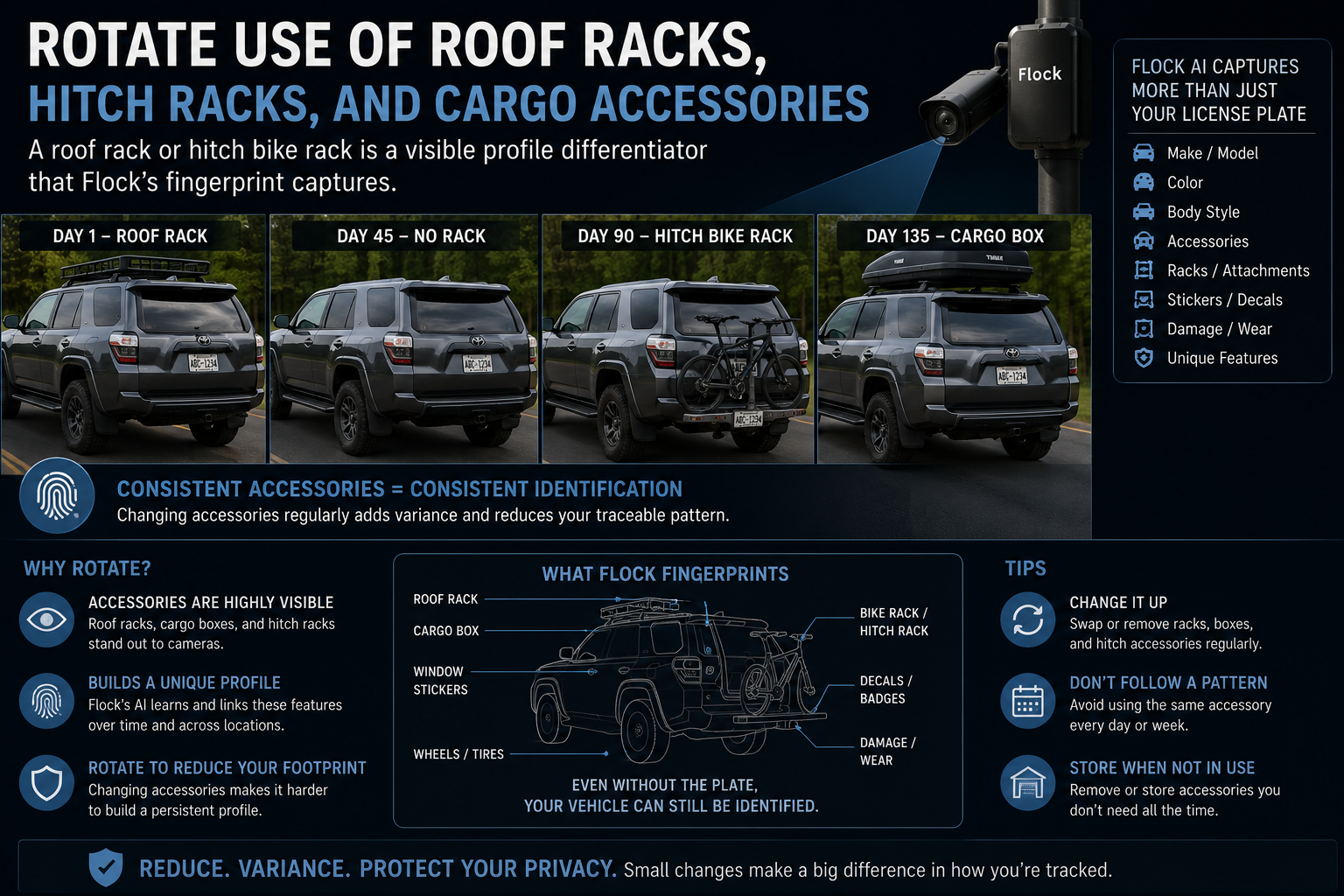
VISIBLE EQUIPMENT
Racks & Cargo Accessories
Roof racks, hitch racks, cargo carriers, and other equipment become part
of the vehicle’s visible appearance. Remove equipment you no longer use.
KNOW YOUR VEHICLE
Know What Is Actually Required
Keep required plates visible and legal. Do not add unnecessary exterior
identifiers simply because other vehicles commonly have them.
DATA-MINIMIZATION CHECK
KEEP
Required equipment, functional accessories, and markings you actually want.
REMOVE
Dealer advertising, unused racks, old magnets, and identifiers that serve no purpose.
REDUCE
Unnecessary trips, repeated routes, and avoidable fixed-camera observations.
DON’T EXPECT
One changed feature to defeat an ALPR system or make your vehicle anonymous.
You do not owe a surveillance database a more distinctive vehicle.
Keep your vehicle legal, safe, and functional. Beyond that, you can decide
how much unnecessary identifying information you want to display.
Section 5 · Cut Other Data Feeds
The Roadside Camera Is Only One Collector
Reducing ALPR collection means less if your vehicle, home camera, parking app,
insurer, and online accounts are simultaneously creating additional records
about the same vehicle and its movements.
The Vehicle Data Stack
YOUR VEHICLE
│
├── roadside ALPR
│
├── connected-car services
│
├── parking apps
│
├── toll / access accounts
│
├── insurance telematics
│
├── cloud security cameras
│
└── public vehicle photos
    │
    ▼
MORE SEPARATE DATA SOURCES
THAT CAN ADD CONTEXT
🚘 Connected Vehicle
Review your automaker account and vehicle privacy controls.
Disable optional data sharing and connected services you do not use.
Recheck after app or software updates.
🔔 Home Cameras
Prefer local recording and local control when practical.
Cloud convenience means another company possesses another copy
of your footage.
Give a plate number when a service actually requires it.
Do not permanently save vehicle information simply because an app
makes that the default.
📱 Public Photos
Crop or blur your plate before publicly posting vehicle photographs
when the plate adds nothing to the post.
📡 Toll & Access Accounts
Review the transponders, gated-access credentials, and vehicle accounts
you maintain. Keep the services you actually need.
📈 Insurance Telematics
Before accepting a driving-monitoring discount, understand what the device
or app collects, how long the information is retained, and who receives it.
Ask one question for every connected service:
Do I need this enough to justify another company maintaining another data
connection to my vehicle?
Section 6 · Know the Legal Line
Counter Surveillance Without Crossing the Line
You can map the network, reduce unnecessary data, request audit records,
criticize the program, organize against it, and demand removal.
None of that requires damaging equipment, trespassing, or obscuring a
legally required registration plate.
COUNTER-SURVEILLANCE PRINCIPLE
Target the surveillance program, not the hardware.
Document it. Audit it. Expose misuse. Challenge the contract.
Put the decision before the public and make the government defend
continued operation.
TENNESSEE PLATE RULE
Keep the required plate visible and legible.
Tennessee law requires registration plates to be securely mounted,
clearly visible, and maintained in a clearly legible condition.
Tennessee law also prohibits placing tinted material over a license plate,
even when the plate information remains visible.
The Legal Line
LAWFUL COUNTER-SURVEILLANCE
│
├── map fixed cameras
├── photograph from lawful locations
├── choose ordinary alternate routes
├── reduce unnecessary vehicle identifiers
├── request public records
├── obtain and review audit logs
├── identify searching users
├── document suspected misuse
├── criticize surveillance policy
├── organize residents
├── contact elected officials
└── seek non-renewal / removal


DO NOT
│
├── obscure or alter a required plate
├── use a tinted plate cover
├── intentionally make the plate unreadable
├── damage a camera
├── cover or disable a camera
├── move surveillance equipment
├── interfere with equipment
└── trespass to reach equipment
MARYVILLE PRIVACY · ALERT BULLETIN
WOMEN’S SAFETY · SUSPECTED MISUSE OF POLICE SURVEILLANCE ACCESS
THREAT ADVISORY
If you are being stalked, harassed, or followed by a current or former
partner in law enforcement, consider whether privileged surveillance access
could be part of the abuse.
Flock and other law-enforcement systems can give authorized users access to
searchable vehicle-location information. Reported misuse cases around the
country have involved officers accused of using law-enforcement database
access to monitor spouses, ex-partners, girlfriends, and other people they
knew personally.
Do not confront someone to determine whether they are tracking you.
Prioritize safety, distance, documentation, and help.
IF YOU BELIEVE YOU ARE BEING FOLLOWED
01 · CREATE DISTANCE
Do not confront the person and do not approach a police vehicle.
Create distance and continue toward a place where other people are present.
02 · GO SOMEWHERE PUBLIC
If circumstances allow, proceed to a well-lit, populated public location
or another safe place where you can seek assistance.
03 · NOTE THE POLICE VEHICLE
If you can safely observe it, note the agency, patrol-car or unit number,
license plate, vehicle description, and direction of travel.
Do not get closer just to obtain this information.
04 · NOTE TIME + LOCATION
Note the exact or approximate time, date, road, intersection, business,
parking lot, or other location where the event occurred.
05 · WRITE IT DOWN WHILE FRESH
Once you are safe, write down what happened in sequence: where you went,
what vehicle you observed, when it appeared, how long it remained, and
why the encounter concerned you.
06 · PRESERVE EVIDENCE
Preserve messages, screenshots, call records, photos, videos, witness
information, previous sightings, and other events that may establish a pattern.
07 · SEEK HELP
Tell someone you trust. Seek assistance from a victim advocate,
attorney, domestic-violence resource, or an independent law-enforcement
agency when appropriate.
08 · IF YOU FEEL IN DANGER · CALL 911
If you believe you are in immediate danger or are actively being followed,
call 911. Continue toward a safe, populated location as circumstances allow
and avoid confronting the person yourself.
IF YOU SUSPECT FLOCK OR POLICE DATABASE MISUSE
SUSPECTED SURVEILLANCE ABUSE
│
├── preserve your incident timeline
├── identify police vehicle / unit if safely possible
├── preserve messages + photos + witnesses
├── report suspected misuse
│
├── request preservation of:
│   ├── Flock audit logs
│   ├── plate searches
│   ├── operator / user IDs
│   ├── search timestamps
│   ├── recorded search reasons
│   ├── hotlist activity
│   └── related case / incident numbers
│
└── compare the records
    │
    ▼
WHO SEARCHED?
WHEN?
WHY?
WHAT AGENCY?
WHAT CASE NUMBER?
Preserve first.
If misuse is suspected, ask that potentially relevant audit and search
records be preserved as soon as possible. Do not assume those records
will remain available indefinitely.
THIS IS NOT A THEORETICAL RISK.
Reported ALPR misuse cases around the country have involved allegations
concerning spouses, estranged spouses, ex-partners, girlfriends, romantic
relationships, friends, and associates. The national incidents below show
why access controls and audit logs matter.
NATIONAL ALPR MISUSE PATTERN
Reported cases around the country show why surveillance audit trails
matter. Documented incidents and allegations have involved officers
using ALPR or other law-enforcement database access in connection with
spouses, ex-partners, romantic relationships, friends, and other
personal targets.
REPORTED MISUSE PATTERN
│
├── spouse / estranged spouse
├── ex-spouse
├── girlfriend / boyfriend
├── ex-partner
├── friends and associates
└── other personal targets
    │
    ▼
PRIVILEGED POLICE ACCESS
    │
    ▼
PLATE SEARCH / LOCATION DATA
    │
    ▼
ALLEGED PERSONAL SURVEILLANCE
INCIDENT MAP
Explore Reported ALPR Misuse Cases
Select a marker to review the agency, reported incident, date,
and supporting source associated with the entry.
Map markers identify the city or county associated with a reported
incident and do not represent the precise location where the alleged
conduct occurred.
Criticize surveillance policy, organize with neighbors, contact
elected officials, and participate in public meetings subject to
applicable meeting rules.
FOURTH AMENDMENT
Challenge Mass Location Surveillance
Networked ALPR systems can aggregate individual observations into
searchable historical location information. Constitutional limits
on large-scale ALPR surveillance continue to be litigated.
TENNESSEE PUBLIC RECORDS ACT
Audit the Government
Request contracts, policies, audit records, search records,
correspondence, and other existing government records that are
subject to disclosure.
Don’t touch the camera. Make the owner defend it.
Identify who owns it. Get the contract. Get the policies. Get the audit
trail. Document misuse. Put the surveillance program in front of the public
and ask for non-renewal or removal.
More Collection Is the Product. Less Collection Is the Counter.
The Surveillance Model
MORE CAMERAS
    │
    ▼
MORE VEHICLE OBSERVATIONS
    │
    ▼
MORE CONNECTIONS
    │
    ▼
MORE SEARCHABLE HISTORY
The Counter-Surveillance Model
REMOVE CAMERAS
    │
    ▼
MAP WHAT REMAINS
    │
    ▼
REDUCE UNNECESSARY READS
    │
    ▼
MINIMIZE UNNECESSARY IDENTIFIERS
    │
    ▼
CUT OTHER DATA FEEDS
    │
    ▼
AUDIT THE WATCHERS
    │
    ▼
LESS INFORMATION TO SEARCH
Don’t just accept the network.
Understand it. Map it. Audit it. Reduce the data.
Then take the cameras down through lawful public action.
🤝 Want to help locally?
MaryvillePrivacy.org connects residents interested in public-records work,
City Council turnout, community outreach, and surveillance-policy action.
This page focuses on lawful privacy practices, public records, civic action,
and data minimization. It does not recommend covering, altering, or obscuring
a legally required license plate; damaging, disabling, or interfering with
surveillance equipment; trespassing; or obstructing law enforcement.

 DeFlock