Axon is a major, publicly traded policing-technology company selling weapons + sensors + cloud software that can unify evidence, cameras, and real-time monitoring into one workflow.
The public debate is not “anti-law enforcement” — it’s democracy in action: residents asking how a powerful vendor ecosystem is governed, audited, retained, shared, and expanded.
It often becomes more centralized (more sensors + more integrations + more data in one platform).
Click to open full size.
AXON • PUBLIC SAFETY TECH VENDOR • GOVERNANCE & OVERSIGHT
Who is Axon?
Axon Enterprise, Inc. is a major public safety technology vendor that sells a vertically integrated policing platform: TASER energy weapons, Axon body-worn cameras, and Axon cloud software for digital evidence management, workflows, and real-time operations.
For cities and counties in Tennessee (including Knoxville, Tennessee and Maryville, Tennessee), the key public-policy question is not branding — it is governance: what enforceable limits exist on data collection, retention, searchability, data sharing, and audit logs when systems can integrate automatic license plate reader (ALPR) data, cameras, and real-time monitoring into one ecosystem.
(Axon: https://www.axon.com/)
This page is a resident-facing oversight checklist. It is designed to help the public ask the questions that should be answered before procurement and expansion — not after a system is already operating.
- Axon is a large vendor ecosystem with hardware + recurring cloud/software revenue.
- Platform value increases when agencies connect more sensors and integrate more data sources.
- That makes public guardrails crucial: purpose limits, retention caps, sharing controls, and auditable logs.
The risk is not “a camera.” The risk is aggregation: when ALPR, fixed cameras, private-camera feeds, dispatch workflows, and analytics are unified into a real-time operating picture, it becomes easier to monitor the public at scale — unless strict rules prevent mission creep.
🧩 How the Axon ecosystem can scale
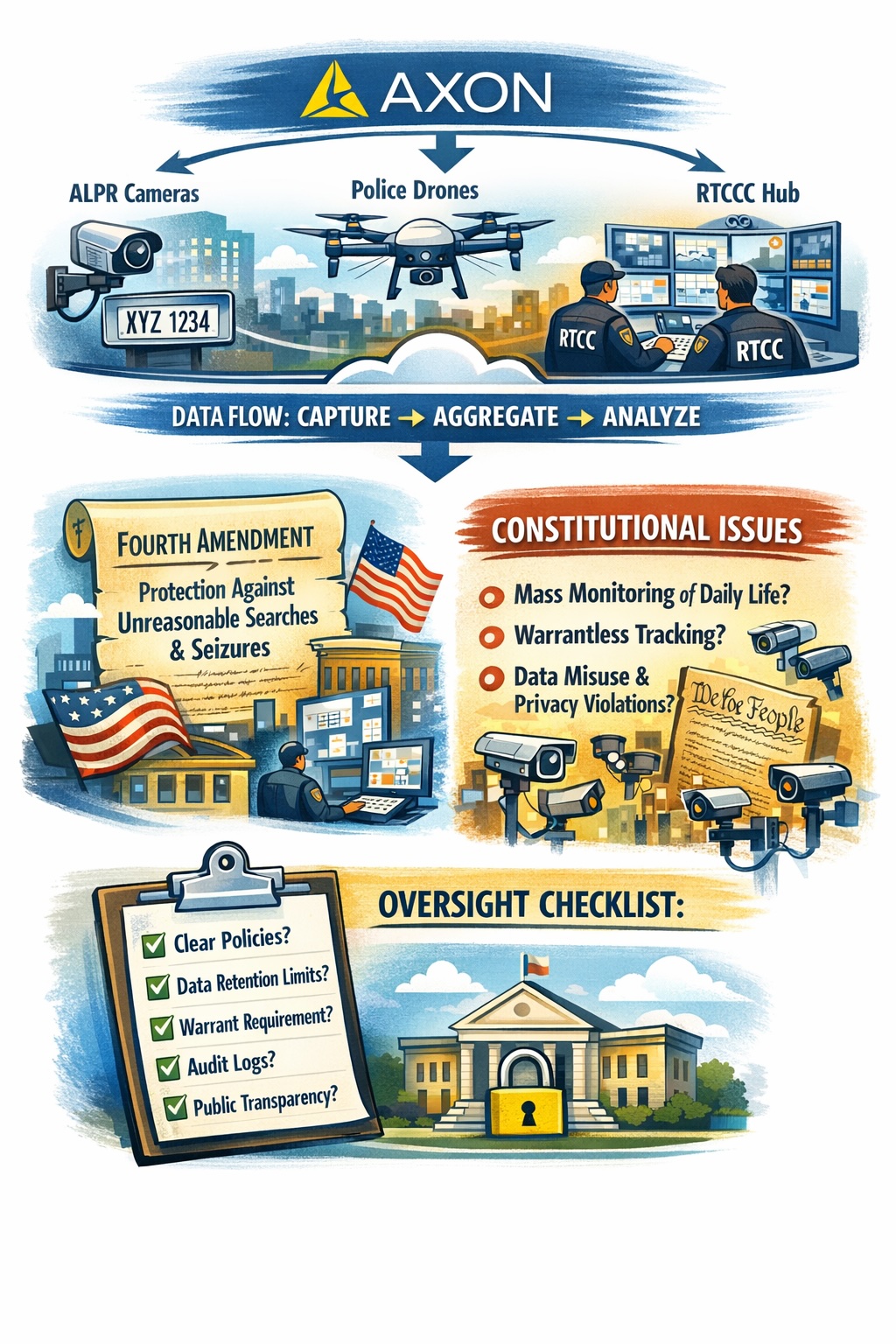
A modern surveillance program is rarely “one device.” It is a pipeline: sensors capture events, data is uploaded to a cloud platform, data is searched/shared, and analytics accelerate action.
The governance risk grows when multiple systems are unified into a single operational picture.
Even if each individual component seems “reasonable,” the privacy impact changes when the system becomes: retained, searchable, shareable, and integrated across jurisdictions — especially when private feeds are included.
What residents should document locally
- What data sources are connected: ALPR, fixed cameras, body cams, private cameras, dispatch, drones, etc.
- Retention periods: by data type (ALPR hits, “non-hit” scans, video, metadata, audit logs).
- Sharing rules: who can access, who can receive exports, and what “network” settings are enabled.
- Audit logging: what is logged, how long logs are kept, who reviews them, and what is publicly reported.
🛰️ RTCC platforms: when “a camera” becomes a citywide operating system
Real-time crime center models are designed to bring multiple feeds into one place: public cameras, private cameras, ALPR signals, and operator workflows.
This can speed response — but it also increases the risk of continuous monitoring without strict written limits.

- Private-camera ingestion: are businesses / HOAs / residents invited to connect their cameras?
- Fusion interfaces: does the platform combine maps, alerts, and search across multiple systems?
- Expansion path: ALPR today, drones tomorrow, broader sensor networks next.
- Governance: written limits on use, strict access roles, public reporting, and independent audits.
Ask your city to publish (1) the RTCC vendor/platform name, (2) a complete list of connected data sources, (3) retention policies by data type, (4) a public audit process, and (5) a ban on suspicionless tracking of ordinary people.
🤖 AI features: speed is not the same as accountability
Some agencies are testing tools that generate draft narratives from audio/video. Even when officers review drafts, residents can reasonably ask: how are errors handled, how is usage disclosed, and what safeguards prevent automation from becoming “rubber stamp” documentation?
- Disclosure: reports should clearly indicate when AI was used.
- Scope limits: only for specific case types, with written exclusions.
- Error accountability: documented process for corrections and discovery.
- Auditability: logs of who generated, edited, approved, and exported drafts.
- Public reporting: how often used, for what categories, and what error rates were found.
⚖️ The concern: mass location monitoring at scale
The constitutional debate is not about whether police can use cameras. It’s about whether modern systems enable long-term, searchable tracking of everyone’s movement — and whether that becomes a Fourth Amendment problem when done at scale without strict safeguards.
- Retention: days vs months vs years.
- Searchability: instant “travel history” queries and cross-jurisdiction lookup.
- Aggregation: ALPR + video + private feeds + maps + analytics.
- Sharing: network access settings and downstream recipients.
- Audit: whether misuse can be detected and proven.
If the system can be used to reconstruct someone’s life patterns (school, work, worship, medical visits, political activity), then the city must publish strict written limits and an independent audit process.
📍 Knoxville, Tennessee: switching from Flock Safety to Axon does not remove the constitutional risk
Knoxville, Tennessee is a useful case study because it shows why residents should focus on policies and safeguards, not vendor names.
If a city moves from Flock Safety ALPR cameras to Axon systems, the constitutional and privacy concerns remain if the new program still enables retained, searchable, and shareable tracking of ordinary people’s movements at scale.
Local reporting described a multi-year Axon deal that included a Real Time Information Center concept — a centralized hub for monitoring and operations that can unify feeds and workflows, including public and private camera sources.
That is an example of platform centralization, where more sensors and more integrations can expand surveillance capacity unless strict written rules prevent mission creep.
- What is the retention period for ALPR “non-hit” scans, ALPR hits, video, metadata, and audit logs?
- Can the system run “travel history” / location history queries? What written standard is required, and what uses are forbidden?
- Who can access the platform, who approves access, and how often are audit logs reviewed by an independent party?
- Are private cameras ingested into a city platform or real-time crime center (RTCC)? If yes, what policy governs access and searches?
- What sharing settings exist (regional networks, federal access, third parties), and who can enable them?
Reference (Knoxville, Tennessee reporting): WVLT described a multi-year Axon deal including a Real Time Information Center concept and monitoring feeds from public/private cameras (see link in Sources).
✅ Minimum safeguards to demand in writing
- Published written policy: who can search, required justification, and forbidden uses (especially non-criminal monitoring).
- Retention caps by data type: ALPR hits, non-hits, video, metadata, and audit logs.
- Sharing restrictions: explicit limits + public disclosure of any network/federal/third-party access settings.
- Audit logs: complete, tamper-resistant logs kept long enough to detect misuse; routine independent review.
- Public reporting: search counts, categories, sharing events, compliance findings, and policy violations.
- Procurement transparency: full contract, renewals, add-ons, integrations, and total cost of ownership.
- No stealth expansion: new data sources (private feeds, drones, analytics modules) require public notice + approval.
If officials cannot explain — in writing — retention, sharing, audit logs, and justification standards, the system is not ready for deployment.
Sources / starting points:
• Axon homepage: https://www.axon.com/
• Knoxville Axon/RTIC local reporting (WVLT): https://www.wvlt.tv/2025/01/08/city-council-approves-multi-million-dollar-contract-knoxville-police-department-after-fiery-meeting/
• Civil liberties analysis on ALPR + location tracking (EFF / ACLU / EPIC)
• Local public records: contracts, policies, invoices, audit logs, sharing settings, governance approvals
MaryvillePrivacy.org informational page about Axon Enterprise, Inc. (Axon), a public safety technology vendor. This page discusses public oversight of policing technology ecosystems, including real-time crime centers (RTCC), automatic license plate reader (ALPR) integrations, public and private camera feeds, digital evidence platforms, data retention, data sharing, audit logs, procurement transparency, and constitutional concerns related to mass location tracking. It includes a Knoxville, Tennessee example to illustrate why switching vendors (for example, from Flock Safety to Axon systems) does not automatically solve surveillance risk without strict written limits, public reporting, and independent audits.